Iranian President Masoud Pezeshkian has rejected the effectiveness of Washington’s latest economic pressure campaign, saying the United States cannot achieve its objectives by trying to squeeze Tehran financially. The remarks came as tensions over the Strait of Hormuz remained high, with Iran warning that a future conflict could extend to energy and communications infrastructure across the region.
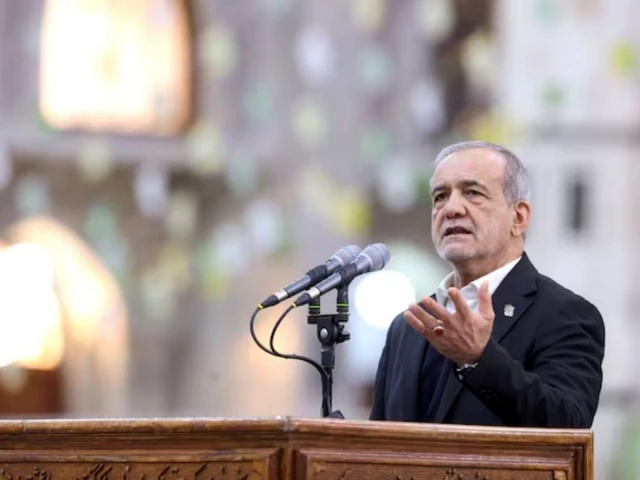
Pezeshkian made the comments during a three-hour meeting at the Central Bank of Iran in Tehran with Economy Minister Ali Madanizadeh, Central Bank Governor Abdolnaser Hemmati and a group of economists.
The meeting examined Iran’s monetary, foreign exchange and financial conditions as the country faces what Pezeshkian described as the combined impact of war, economic restrictions and external pressure.
He called for closer coordination among the government, central bank and other economic institutions to stabilise key markets and contain inflation expectations.
Pezeshkian said Tehran remained open to dialogue and negotiations but would continue resisting economic pressure from Washington.
He also argued that the United States had failed to achieve its objectives during the conflict because of resistance from Iran’s armed forces and public support, saying economic pressure would similarly fail to force Tehran into submission.
Iranian military warns conflict could widen
The warnings from Tehran extended beyond the economic front.
Brigadier General Mohammad Akraminia, an Iranian army spokesman, told the semi-official Mehr News Agency that a possible future war with the United States could spread beyond existing areas of confrontation and involve critical infrastructure.
He said Iran had previously warned that any miscalculation by its adversaries could trigger an immediate response and widen the geographical scope of the conflict.
Akraminia specifically referred to the Bab al-Mandab Strait and a US military base in Syria, saying developments in those areas had already demonstrated how quickly the conflict could expand.
He warned that energy facilities and communications infrastructure could also become part of a future confrontation.
The official pointed to energy and communications links running through waters around Iran, the Arabian Peninsula and the Gulf of Oman.
His remarks underscored the broader regional risks surrounding the confrontation, particularly as international shipping and energy markets remain sensitive to developments around the Gulf.
Pakistan and IMF Clash Over Public Procurement Rules for State Firms
Missing Iranian pilots become another point of tension
Akraminia also called on Qatar to intensify efforts to establish the fate of three Iranian pilots who went missing following an Iranian air operation against a US base in Qatar on March 2.
According to the Iranian military spokesman, two Sukhoi aircraft struck the base before being shot down while returning.
The body of one pilot, Majid Kazemi, was later recovered, while three others remained missing.
Qatar has denied holding the missing pilots. Its authorities said search-and-rescue teams recovered the remains of one pilot but found no evidence that the other three had been captured.
Washington warns against using Hormuz as leverage
The United States has meanwhile maintained pressure on Tehran while warning against disruptions to international shipping.
US Treasury Secretary Scott Bessent told Bahrain’s Minister of Finance and National Economy Sheikh Salman bin Khalifa that Iran should not be allowed to threaten international commerce or use the Strait of Hormuz as leverage over the global economy.
Washington has also indicated that it intends to maintain financial pressure on Iran and target individuals and entities helping the country maintain its economic lifelines.
The US Treasury’s latest sanctions campaign has targeted dozens of individuals, entities and vessels as part of a broader effort to isolate Iran economically.
The pressure comes as the strategic waterway remains at the centre of the wider dispute. The Strait of Hormuz has historically carried a major share of global oil and liquefied natural gas shipments, making any disruption there a concern for international energy markets.
Iran and Oman agree on temporary transit corridor
Against the backdrop of the confrontation, Iran and Oman have been working on a temporary navigation arrangement through the Strait of Hormuz.
Iranian Deputy Foreign Minister Kazem Gharibabadi said the two countries had agreed on a seven-mile-wide transit route, while stressing that the arrangement did not amount to a full reopening of the strategic waterway.
He said the proposed corridor would pass through Iranian territorial waters on entry, with part of the exit route also passing through Iranian waters.
Further talks between Tehran and Muscat are expected to take place over the coming weeks to determine a permanent arrangement and the future management of shipping through the strait.
Iranian officials continue to insist that the waterway remains under Tehran’s control.
Gharibabadi said activating the proposed route would also involve changes to the existing southern passage, with technical discussions expected to determine an alternative route.
Iran and Oman have also discussed mine clearance and navigational safety as part of efforts to establish a more workable shipping arrangement. Reuters reported that the countries were negotiating a temporary corridor after months of disruption to maritime traffic.
Tehran rejects US claims over mines
Gharibabadi also dismissed reports that American forces had cleared mines from the waterway or were preparing to deploy mine-sweeping vessels.
He questioned why US ships had not used the route if Washington was certain the mines had been removed.
The Iranian official warned that US mine-sweeping vessels entering the area would be regarded as legitimate military targets by Iran.
US President Donald Trump has separately claimed that mines in international waters had been removed or detonated and warned Iran against laying additional mines.
The competing claims highlight the continuing uncertainty surrounding the safety of one of the world’s most strategically important maritime routes.
Egypt urges diplomacy and de-escalation
Egypt has called for greater diplomatic efforts to prevent the conflict from spreading.
Egyptian Foreign Minister Badr Abdelatty discussed regional developments with US Special Envoy to the Middle East Steve Witkoff in a telephone call, according to Egypt’s Foreign Ministry.
Abdelatty stressed the importance of implementing the US-Iran memorandum of understanding and described the agreement as a possible foundation for reducing tensions and improving regional stability.
He also called for stronger international efforts to protect freedom of navigation and prevent disruption to international waterways.
Egypt said safe maritime passage was essential to global trade, supply chains and energy security.
US appears to shift away from immediate strikes
The latest diplomatic signals suggest Washington may be placing greater emphasis on economic and maritime pressure rather than launching additional military strikes in the immediate future.
US Secretary of State Marco Rubio reportedly told several allied foreign ministers that the United States was not expected to carry out new strikes against Iran “for the time being”, according to Axios. The administration is instead focusing on sanctions and other forms of economic pressure.
The reported shift comes as Pakistan continues its diplomatic efforts involving Iran and the United States. Pakistan and Iran made what Islamabad described as significant progress in recent discussions focused on the conflict and possible avenues towards peace.
For now, the standoff remains centred on competing economic and strategic pressure. Tehran says sanctions will not force it to surrender, while Washington is seeking to weaken Iran’s remaining economic channels without immediately expanding military operations.
The temporary navigation discussions between Iran and Oman could provide a limited opening for international shipping, but a broader settlement remains uncertain. With energy infrastructure, maritime trade and regional security all tied to the dispute, developments around the Strait of Hormuz are likely to remain closely watched by governments and global markets.










[…] Strait of Hormuz Tensions Rise as Iran Rejects US Economic Pressure […]