Chinese robot makers are shifting their focus from flashy demonstrations to commercial applications as humanoid robots begin sorting parcels, packing smartphones and performing household tasks.
More than 300 mostly Chinese companies are taking part in the World Robot Conference in Beijing. Organisers said the event features more than 2,000 exhibits and over 150 new products.
The conference runs through Sunday as investor interest in humanoid robots continues to grow. China sees the technology as a potential source of industrial growth and a key area of competition with the United States.
Robots Take on Factory and Warehouse Jobs
Several companies used the conference to demonstrate robots performing practical tasks.
Leju showed humanoids moving crates and sorting small objects. Assistant Vice President Zhang Dapeng said European factories and Chinese automotive plants were already using its robots to move boxes and load components.
Robotera displayed a humanoid torso mounted on a wheeled tripod. The robot sorted parcels using the company’s artificial intelligence software.
A company representative said Robotera had deployed more than 100 parcel-sorting robots across 15 warehouses in China. The robots have also worked at China Post logistics facilities since last year.
DexForce demonstrated humanoids packing mobile phones into boxes on an assembly line. Company official Nicole Yang said the robots have worked at a Lens Technology factory since early this year.
The machines can operate with millimetre-level accuracy and identify problems such as incorrectly positioned phones.
Misbah Arshad Crowned Miss Universe Pakistan, Set to Represent Country Globally
Household Robots Move Closer to Commercial Use
Some companies are also targeting homes rather than factories.
X Square Robot is testing household robots in hundreds of homes this year. The company plans to move towards gradual commercialisation next year.
Co-founder Yang Qian said the company’s longest home deployment has lasted one month.
The company hopes to expand beyond short-term trials as robots become more capable of handling everyday household tasks.
Unitree IPO Fuels Investor Interest
The growing commercial push comes as investors show strong interest in China’s humanoid robot industry.
Unitree, one of China’s best-known humanoid robot makers, saw its shares surge nearly sixfold during its Shanghai trading debut on Wednesday.
The company’s initial public offering attracted retail demand more than 8,000 times the available shares.
Other robotics companies are also considering stock market listings. Lumos Robotics and Chery Automobile’s robotics division recently told Reuters that they were exploring potential IPOs.
Nvidia Executive Visits Beijing Conference
Madison Huang, a senior Nvidia executive and daughter of CEO Jensen Huang, made an unannounced visit to the conference.
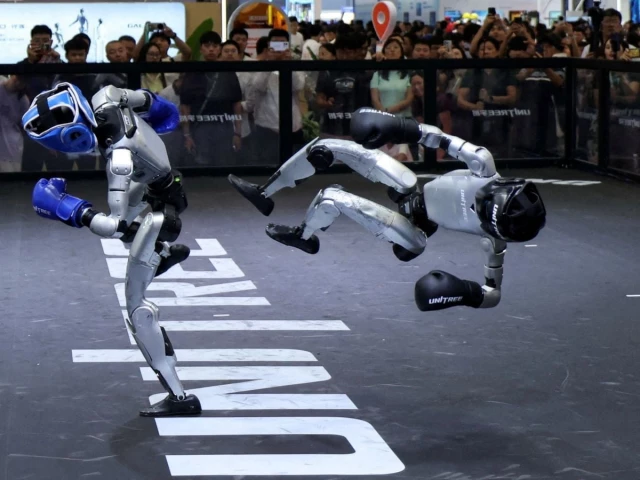
She watched humanoid robots perform flying kicks and dance routines before visiting a companion-robot booth. She also asked about the sensors used by the robots.
Huang oversees marketing for Nvidia’s Omniverse and robotics platforms. The software helps companies simulate and test physical AI systems that can perceive and interact with the real world.
Her visit highlighted the continued role of foreign technology suppliers in China’s robotics industry despite US restrictions on advanced Nvidia chips.
US-based RealSense, which develops vision systems for robots, was among the few foreign exhibitors at the event.
“We see China as a very strategic market for us,” said Mike Nielsen, the company’s chief marketing officer. “It is becoming the center of humanoid technology.”
China Pushes Robotics Into Daily Life
Chinese Vice Minister of Industry and Information Technology Xin Guobin described robotics as an “important force” in the country’s economic and social development.
Companies are increasingly testing humanoids in logistics, manufacturing and service industries.
The shift reflects a broader challenge for China’s robotics sector: proving that humanoids can deliver reliable commercial value rather than simply attract attention at exhibitions.
RealSense’s Nielsen said companies that successfully place robots into active production environments are most likely to succeed.
He also noted that China’s fast development cycle is forcing robotics suppliers to move quickly.
“The product cycles for robots are more like six to eight months, not three to four years,” Nielsen said.












[…] China’s Humanoid Robots Move From Showpiece Demos to Real-World Jobs […]