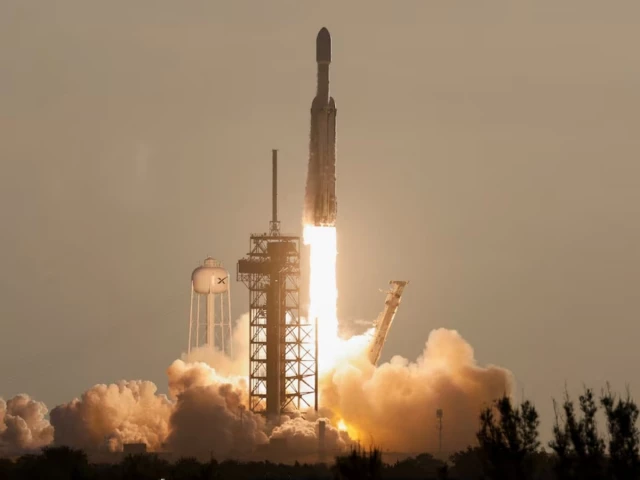
NASA’s Roman Telescope has begun its journey into space, launching from Florida on Sunday aboard a SpaceX Falcon Heavy as part of an ambitious mission to investigate some of the universe’s most fundamental mysteries.
The Nancy Grace Roman Space Telescope, a project costing roughly $4 billion, lifted off from NASA’s Kennedy Space Center under mostly clear skies despite earlier concerns about weather conditions.
The observatory is designed to investigate dark energy and dark matter, examine how gravity behaves across enormous distances and search for planets beyond our solar system.
After launch, Roman will travel towards Lagrange Point 2, an orbital location approximately 1 million miles (1.6 million kilometres) from Earth. NASA has planned an initial five-year mission, although the telescope could potentially continue operating for another five years depending on its fuel supply.
A new view of the universe
Roman is expected to complement the work of the James Webb Space Telescope and the Hubble Space Telescope rather than simply replace them.
NASA Science Mission Directorate chief Nicola Fox described the difference by comparing Hubble and Webb to instruments that have looked through a narrow opening, while Roman will provide a much broader view of the cosmos.
Roman has a level of sensitivity and image sharpness broadly comparable to Hubble but is designed to survey enormous sections of the sky far more rapidly.
Julie McEnery, Roman’s senior project scientist at NASA’s Goddard Space Flight Center, said the telescope could survey the entire Milky Way in about a month.
A comparable survey using Hubble would take roughly a century, according to McEnery.
The difference reflects Roman’s wide field of view. NASA compares the observatory to a camera’s wide-angle lens, while Webb operates more like a zoom lens, allowing scientists to study distant objects in exceptional detail.
Webb has already transformed scientists’ understanding of the early universe, including observations suggesting that some primordial galaxies formed earlier and grew larger than previously expected.
Roman will provide a complementary panoramic perspective, allowing researchers to study huge populations of galaxies and cosmic structures simultaneously.
Mapping dark matter and dark energy
One of Roman’s central objectives is to investigate the two mysterious components believed to dominate the universe: dark matter and dark energy.
The telescope is expected to produce one of the most detailed three-dimensional maps of the cosmos ever created. Its primary survey will take more than a year and is expected to cover more than two billion galaxies.
Scientists estimate that ordinary matter — including stars, planets, gas and dust — accounts for only about 5% of the universe. Dark matter is thought to make up roughly 27%, while dark energy may account for about 68%.
Dark matter cannot be observed directly but is inferred from its gravitational effects on galaxies and other cosmic structures.
Dark energy is the name given to the unknown phenomenon believed to be driving the accelerating expansion of the universe.
Scientists discovered in 1998 that the expansion of the universe was speeding up, fundamentally changing understanding of cosmic evolution.
Roman will study how dark matter influences the structure of the universe and how dark energy affects its expansion. Researchers hope those observations will provide important clues about the nature of both phenomena.
Searching for new worlds
The telescope will also conduct one of the most extensive searches for exoplanets ever undertaken.
Scientists expect Roman to discover thousands of planets outside the solar system and help establish a statistical picture of planetary systems throughout the galaxy.
Such observations could help researchers understand how common different types of planetary systems are and how our own solar system compares with them.
Mustapha Ishak, a cosmologist at the University of Texas at Dallas and a member of Roman’s scientific collaboration, said the observatory’s potential for unexpected discoveries was among its most exciting features.
Historically, major astronomical observatories have often produced important discoveries in areas scientists did not anticipate before launch, he noted.
Hania Aamir’s Latest Travel Photos Highlight Her Bold Fashion Sense
Building on Hubble and Webb
Roman’s mission will extend the capabilities of the space observatories already transforming modern astronomy.
Hubble, launched in 1990, has provided decades of observations of galaxies, stars and other cosmic phenomena. Webb, launched in 2021, has expanded the ability to observe extremely distant and ancient objects.
Roman is designed to operate alongside both telescopes, combining a wide field of view with advanced sensitivity.
Its broad surveys could identify interesting objects and regions for Webb and other observatories to examine in greater detail.
The combined capabilities are expected to give scientists a more complete picture of how galaxies, stars and planetary systems develop across cosmic history.
Mission survives funding challenges
Roman’s development faced political and budgetary uncertainty during both of Donald Trump’s presidential terms, when his administration sought to reduce or eliminate funding for the project.
Congress ultimately preserved funding for the telescope, allowing development to continue.
NASA said the launch occurred nine months earlier than previously scheduled.
With its journey now underway, Roman is set to become one of the most powerful tools for surveying the universe on a massive scale — potentially reshaping scientists’ understanding of dark matter, dark energy, exoplanets and the evolution of the cosmos.











[…] NASA’s Roman Telescope Launches to Unlock the Universe’s Biggest Mysteries […]