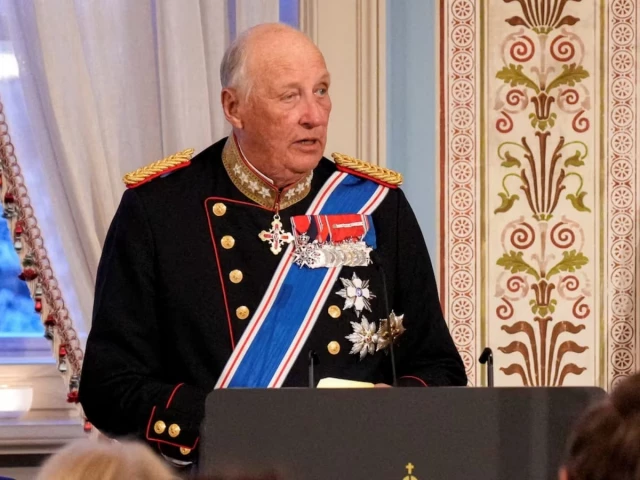
Norway’s King Harald has died at the age of 89, bringing an end to a 35-year reign during which he transformed the image of the country’s monarchy while becoming one of its most recognisable and trusted national figures.
The Royal Court said Harald died peacefully at Oslo University Hospital at 6:35 a.m. local time on Friday, August 28. He had been receiving treatment after developing a bacterial infection in his bloodstream and had been in hospital since August 17.
His death marks the close of one of Europe’s longest modern royal chapters. Harald became king in January 1991 following the death of his father, King Olav V, and remained determined to fulfil his constitutional role despite repeated health problems in his later years. The Royal Court described his duties as largely representative and ceremonial, but his influence often extended far beyond formal responsibilities.
A Monarch Close to the Norwegian People
King Harald was particularly admired for the personal way he responded to moments of national tragedy. Following the 2011 attacks in Oslo and on Utøya, in which 77 people were killed, he became an important voice of consolation and national unity.
His public appearances after floods, storms and other disasters further strengthened his reputation as a monarch willing to stand alongside ordinary Norwegians. He was often seen visiting affected communities, speaking with families and offering support during difficult times.
Harald also helped move the Norwegian monarchy towards a more open and modern identity. Rather than maintaining a distant royal image, he frequently spoke about tolerance and the diversity of Norwegian society.
Modernising the Norwegian Monarchy
His marriage to Sonja Haraldsen, a commoner, represented a break with traditional royal expectations when the couple married in 1968. Their relationship helped reflect the changing social values of Norway and contributed to the royal family’s more accessible public image.
The king’s popularity endured despite periods of controversy surrounding the monarchy. Public support for the institution declined during 2026 amid wider difficulties affecting the royal family, but Harald himself continued to receive strong personal approval.
A February poll cited by Reuters gave him a score of 9.2 out of 10 among members of the Norwegian royal family, highlighting the respect he continued to command among the public.
A Passion for Sailing and Nature
Harald’s life also reflected his interests beyond royal duties. He was a competitive sailor who represented Norway at several Olympic Games and won a world championship title.
Although he did not match his father’s achievement of winning Olympic gold, sailing remained one of his lifelong passions. He was also known for maintaining a personal interest in cars and often drove himself to informal engagements.
The king developed a lasting interest in environmental issues. At the age of 76, he travelled deep into Brazil’s Amazon rainforest, where he spent several days living among the Yanomami people. The journey fulfilled a long-held personal ambition and reflected his interest in nature and indigenous communities.
PSX Gains 446 Points as KSE-100 Nears 177,800 Before Break
Childhood Shaped by War
Harald’s childhood was shaped by war and exile. Born on February 21, 1937, he was the first Norwegian royal heir to be born in the country in nearly six centuries.
When Nazi Germany invaded Norway in 1940, the young prince left the country with his mother and sisters. The family eventually travelled to the United States, where Harald spent part of his childhood and met President Franklin D. Roosevelt.
After returning to Norway in 1945, Harald attended public schools before beginning military training and preparing for his future constitutional role. His experience abroad and his upbringing during wartime contributed to the modern outlook that later became a defining feature of his reign.
Health Problems in His Final Years
Harald remained committed to the principle that the Norwegian monarchy was a lifelong responsibility. Even when questions about abdication emerged during his later years, he rejected the idea and said he intended to remain king for life.
His final years were marked by increasing health concerns. In 2024, he was hospitalised in Malaysia after developing an infection and received a temporary pacemaker before returning to Norway. A permanent pacemaker was subsequently fitted.
Earlier this month, his condition deteriorated after he developed a bloodstream infection. The Royal Court later confirmed that he had died peacefully at the Oslo hospital.
Crown Prince Haakon Begins a New Era
Harald’s death brings a significant transition for Norway. His son, Crown Prince Haakon, has succeeded him as monarch following his father’s death.
Reuters reported that Haakon, 53, ascended the throne immediately, beginning a new chapter for the Norwegian royal family. His wife, Crown Princess Mette-Marit, is expected to become queen as the new reign takes shape.
The succession comes at a challenging time for the royal household, which has faced scrutiny over personal controversies and health concerns. Haakon will now be expected to preserve the monarchy’s public standing while establishing his own style of leadership.
A Lasting National Legacy
For many Norwegians, Harald will be remembered less for ceremony than for his ability to connect the monarchy with everyday life. His reign combined tradition with gradual reform, while his public presence during times of grief helped reinforce the monarchy’s role as a symbol of national community.
After more than three decades on the throne, Norway has lost a monarch who largely avoided grandiosity and instead built his reputation through continuity, openness and a visible sense of duty.
His passing leaves the country facing a new royal era while closing one of the most distinctive chapters in modern Norwegian history.










[…] King Harald Dies at 89 After 35 Years on Norway’s Throne […]