Iranian Foreign Minister Abbas Araghchi has said diplomacy with the United States can return to the table if Washington recognises that economic pressure is ineffective, as tensions over sanctions and the Strait of Hormuz continue to dominate regional diplomacy.
Araghchi said on Friday that restoring diplomacy was not impossible, but depended on a change in the US approach. He called for Washington to build trust, communicate respectfully, recognise Iran’s rights and honour its commitments. Diplomacy remains possible, he suggested, but only if the United States moves away from what Tehran views as a policy of coercion.
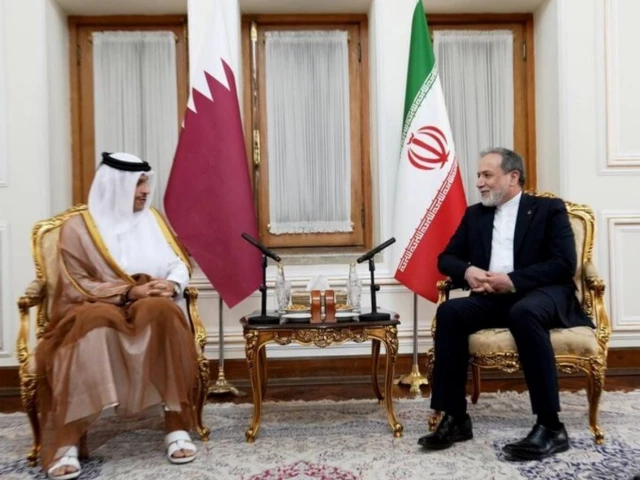
His remarks followed a meeting with Qatar’s Prime Minister and Foreign Minister Jassim Al Thani, who travelled to Tehran as part of Doha’s efforts to reduce tensions between Iran and the US.
Sheikh Mohammed held talks with Iranian President Masoud Pezeshkian, Araghchi, Parliament Speaker Mohammad Bagher Qalibaf and Secretary of Iran’s Supreme National Security Council Mohsen Rezaei. Discussions reportedly focused on creating conditions for renewed dialogue, alongside proposals concerning navigation through the Strait of Hormuz and efforts to address maritime mines.
The visit was the Qatari foreign minister’s first trip to Iran since the conflict began with US and Israeli strikes in late February.
Tehran and Washington trade accusations
Iranian officials have continued to reject the effectiveness of US economic pressure. Araghchi said Washington must recognise that pressure does not work if it wants to restore diplomatic engagement.
Iranian Parliament Speaker Mohammad Bagher Ghalibaf separately criticised US Treasury Secretary Scott Bessent after the American official accused Tehran of spending large sums overseas while ordinary Iranians face economic difficulties.
Ghalibaf responded by accusing Washington of directing substantial resources towards overseas allies and military bases. His comments reflected the increasingly confrontational rhetoric between Tehran and Washington as both sides dispute the causes of Iran’s economic difficulties.
The exchange came after Bessent argued that Iran should prioritise domestic needs rather than supporting foreign partners and groups.
The dispute is unfolding against the backdrop of a 14-point memorandum of understanding reached by Iran and the US in June with mediation from Pakistan and Qatar. The agreement included provisions concerning an end to hostilities, the Strait of Hormuz, the lifting of a US naval blockade and the beginning of a 60-day negotiating process.
Tehran has accused Washington of failing to fulfil key commitments under the memorandum. Iranian officials have repeatedly linked any full reopening of the strategic waterway to the implementation of those commitments.
Karachi-Rohri Rail Track to Begin Construction Next Year as Pakistan Expands Fuel Transport
Conflicting claims over Strait of Hormuz
The status of the Strait of Hormuz remains one of the most sensitive issues in the standoff.
Iranian Deputy Foreign Minister Kazem Gharibabadi said Tehran and Oman had agreed on a temporary seven-mile-wide transit route through the strait. He stressed, however, that the arrangement should not be interpreted as a full reopening of the waterway.
Iran maintains that it retains control over the strait and considers the waterway a national-security issue. Tehran has also rejected US claims concerning mine clearance.
The US military, meanwhile, offered a sharply different account.
US Central Command said American forces had cleared sea mines from internationally recognised shipping lanes and that commercial navigation routes were open. Commander Adm. Brad Cooper said US forces had assisted almost 1,500 commercial vessels in recent months, carrying roughly 750 million barrels of crude oil to global markets.
Cooper also claimed that the US had turned around 75 vessels attempting to breach its maritime blockade and disabled three that failed to comply with directions.
The competing claims underline the uncertainty surrounding commercial navigation through one of the world’s most important energy corridors.
Iran warns of economic retaliation
Iran has also warned that continued maritime pressure could trigger retaliation against American economic interests.
Mohsen Rezaei, secretary of Iran’s Supreme National Security Council, said on Thursday that Tehran would respond forcefully if the maritime blockade continued.
He claimed Iran had managed to overcome the blockade during the ceasefire and had exported between 70 million and 80 million barrels of oil. Rezaei also said Iranian oil sales had returned to levels seen before the sanctions regime and that Tehran was developing additional export routes.
His comments suggest that Iran views control over energy exports and maritime access as important elements of its response to US pressure.
Rezaei also addressed developments in Lebanon, warning that Beirut and its southern suburbs represented a red line for Tehran. He said Iran was closely monitoring the situation and predicted that Israel would eventually be forced to withdraw from occupied areas in Lebanon.
Qatar pushes for de-escalation
Qatar’s diplomatic activity has emerged as an important channel between Tehran and Washington. Sheikh Mohammed’s visit to Iran came as Doha sought to create conditions for renewed dialogue and reduce the possibility of further escalation.
Egypt has also called for implementation of the US-Iran memorandum and greater diplomatic efforts to contain regional tensions. Several regional governments have stressed the importance of protecting international waterways and keeping energy routes open.
For now, Tehran appears to be signalling that it remains open to negotiations, but only under conditions it considers acceptable. Washington, meanwhile, continues to combine economic and maritime pressure with demands on Iran.
The future of the Strait of Hormuz, and whether diplomacy can prevent another escalation, is therefore likely to remain at the centre of the wider regional crisis.








[…] Iran Says Diplomacy Is Still Possible as Hormuz Tensions Rise […]