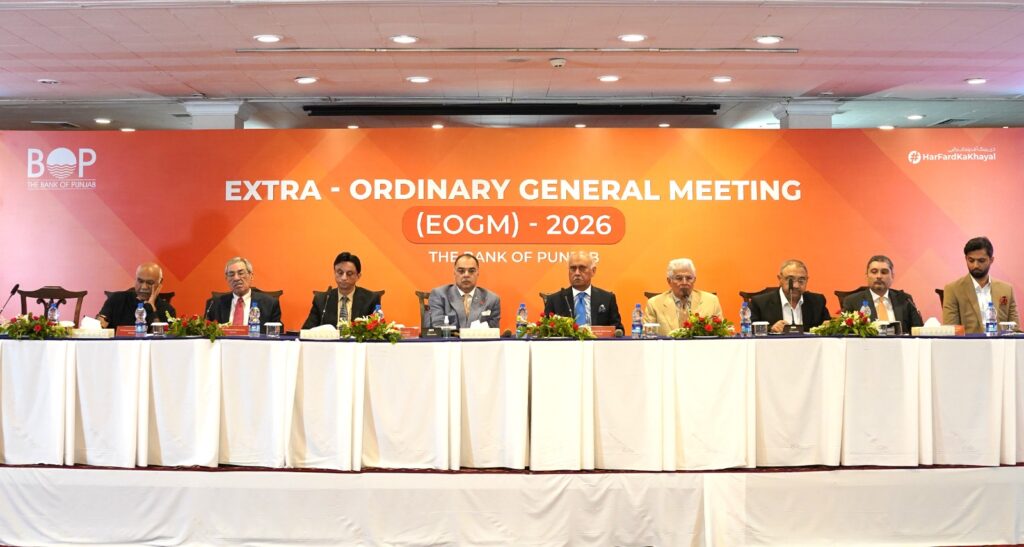
Shareholders of The Bank of Punjab (BOP) have unanimously approved a proposed equity injection of up to PKR 30 billion by the Government of Punjab.
The approval came at an Extraordinary General Meeting held by the bank. The new ordinary shares will be issued directly to the provincial government rather than through a rights issue.
BOP President and CEO Zafar Masud also addressed questions raised by shareholders. According to the bank, shareholders received satisfactory responses to their concerns.
The Bank of Punjab equity injection is aimed at supporting the bank’s future growth. It will also improve its ability to mobilise deposits and expand lending across key business segments.
Punjab Government to Provide Growth Capital
BOP currently ranks among the lowest-capitalised banks within Pakistan’s 10 largest banks. Its Tier-1 capital stands at PKR 99.9 billion, compared with total assets of PKR 2,952 billion.
The bank said the additional capital will support expansion across corporate, commercial, SME, agriculture, housing, digital and Islamic banking.
It will also support the bank’s proposed overseas wholesale banking unit.
The stronger capital base could help BOP compete more effectively with larger banks. In particular, it could improve the bank’s capacity to attract low-cost deposits.
The Punjab government’s decision also reflects its confidence in the bank’s financial performance, according to BOP.
The bank has paid more than PKR 15 billion in dividends since 2021. This includes PKR 3 billion during the first six months of 2026.
BOP Highlights Investment Returns
BOP said the value of the Punjab government’s investment has increased approximately seven-fold over the same period.
The bank also noted that its stock ranked as the best-performing banking stock in Asia in 2025.
Awn Chaudhry Visits Workers Welfare Fund Secretariat, Reviews Welfare Initiatives
BOP stressed that the proposed equity represents general growth capital rather than funds intended to address portfolio stress.
All deployment of the new capital will remain subject to the bank’s existing credit, risk, pricing and profitability standards. This will also apply to government-related business.
Direct Subscription Offers Greater Certainty
BOP said a rights issue of this size could have created uncertainty over subscription levels, timing and completion.
According to the bank, around 80% of recent rights issues on the Pakistan Stock Exchange were priced at a discount.
Of the 10 rights issues launched since November 2024, only two were priced at a premium. Both were also substantially smaller than the proposed BOP transaction.
A direct subscription by the Punjab government will provide committed capital with greater certainty over the amount and timing.
The shares will also be issued at a premium to the market price and break-up value. This structure will reduce the number of new shares required and limit dilution.
Minority shareholders will not need to provide additional funds. However, they will continue to participate in the benefits of a stronger capital base.
BOP Reports Improved Asset Quality
The bank said it continues to comfortably meet regulatory capital and leverage requirements. It also holds an AAA long-term credit rating.
BOP’s non-performing loan ratio has fallen from 9.7% in 2021 to 4.8% in the first half of 2026.
The weighted obligor risk rating has also improved to 3.6 from above 4.0 three years ago.
Punjab government schemes account for around PKR 182 billion, or approximately 18% of BOP’s portfolio. More than 17% of this amount is covered by a government guarantee.
According to BOP, these schemes account for only 3% of its total non-performing loans. Recovery rates across major programmes range from 97% to 100%.
The bank therefore described the equity injection as a proactive growth measure rather than a response to financial stress.
New Shares to Carry Premium
BOP said the new shares will be issued at the higher of PKR 38.20 per share or the prevailing market price plus a 5% premium.
The PKR 38.20 floor price was determined by independent valuer KPMG Taseer Hadi & Co.
The floor price is approximately 20% above the audited break-up value of PKR 31.83 per share.
Therefore, the shares cannot be issued below PKR 38.20 or at a discount to the prevailing market price.
The premium will increase the bank’s net assets for the benefit of all shareholders.
Following a full injection at the floor price, the Punjab government’s shareholding would rise from 57.47% to 65.71%.
BOP said minority shareholders would remain above all principal statutory thresholds. The issuance would also not provide the majority shareholder with any new powers.
Equity Injection to Be Issued in Phases
BOP expects a short-term mechanical decline in earnings per share and return on equity if the new shares are counted before the capital is fully deployed.
However, the bank plans to raise and deploy the capital in phases.
BOP expects the funds to support profitable and risk-adjusted growth. It said incremental earnings should absorb the initial dilution and keep post-injection return on equity competitive with the industry.
The bank also expects book value per share to increase rather than decline. The new shares will rank pari passu for dividends declared after issuance.
Subject to regulatory approvals, BOP expects to issue PKR 15 billion to PKR 20 billion worth of shares to the Punjab government by December 31, 2026.
The remaining PKR 10 billion to PKR 15 billion is expected by June 30, 2027.
No shares will be issued until all statutory and regulatory requirements have been fulfilled.
Masud described the transaction as growth capital for an expanding bank.
“This is growth capital for a growing bank. The Bank of Punjab is well capitalised, liquid and sound; we are creating the capacity required for the scale of business we intend to undertake.”
He added that the pricing was transparent and market-linked, while the premium would accrue to the bank.
“Any dilution shareholders may see on paper is temporary; the capital, capacity and earnings it enables are enduring,” Masud said.