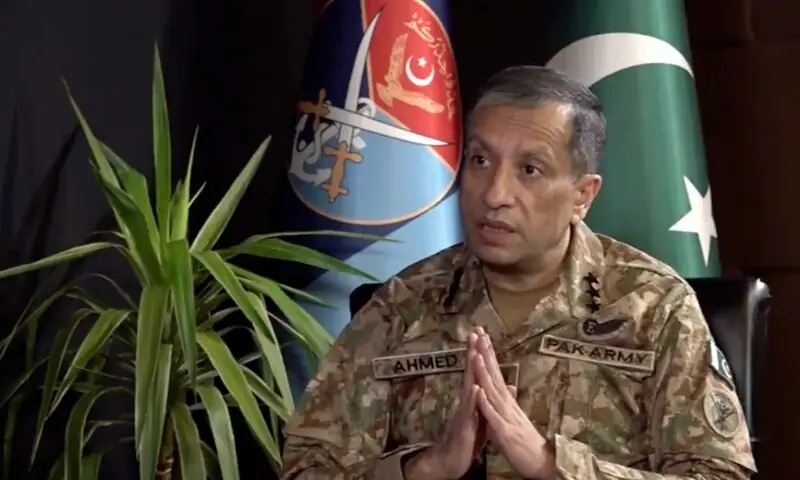
Pakistan is providing the support needed to defend Saudi Arabia amid attacks by Yemen’s Houthi rebels, Director General Inter-Services Public Relations (DG ISPR) Lieutenant General Ahmed Sharif Chaudhry has said.
In an interview with Independent Arabia, aired on Sunday, the military spokesperson reaffirmed Pakistan’s commitment to Saudi Arabia’s sovereignty, territorial integrity and security.
He also stressed the importance of protecting the Two Holy Mosques. “It’s non-negotiable; it’s absolute as far as Pakistan is concerned […] So whatever support is needed to do that is being provided and will be provided,” he said.
However, Chaudhry declined to disclose specific details about the support. He explained that military alliances generally do not publicly reveal the nature or scale of their assistance.
Pakistan Reaffirms Commitment to Saudi Arabia
The DG ISPR said Pakistan’s public and leadership had strongly condemned threats against Saudi Arabia and its holy sites.
Maryam Nawaz Launches Second Phase of Laptop and Scholarship Schemes Azma Bokhari
“Our reaction in Pakistan, on the streets, from a young boy and girl up to our political and military leadership, is one of anger,” he said.
He questioned why anyone would threaten the kingdom or the holy places. Furthermore, he said Pakistan’s position on the security of the holy sites left no room for ambiguity.
Chaudhry also addressed whether Pakistan’s support would remain defensive if Houthi attacks continued. He said Pakistan, Saudi Arabia and Türkiye were clear about the defensive nature of their Makkah Joint Defence Agreement.
According to the military spokesperson, the agreement seeks to strengthen collective deterrence rather than initiate offensive action against another country.
Makkah Defence Agreement Provides for Collective Response
The Makkah Joint Defence Agreement was signed by Pakistan, Saudi Arabia and Türkiye on August 7, 2026. The agreement states that an armed attack against one member will be regarded as an attack against all three.
Chaudhry referred to Article 51 of the United Nations Charter, which recognises the inherent right of individual and collective self-defence.
He said the agreement sends a strong message to actors threatening regional stability. Moreover, he warned that the three countries would use available means to restore deterrence if it failed to prevent aggression.
At the same time, the military spokesperson emphasised that the agreement was not directed against any specific country.
“It is [formed] to have peace, stability and security in the region,” he said, adding that any actor threatening those objectives could trigger the collective deterrence mechanism.
Pakistan Engaging Regional Parties to Reduce Tensions
Chaudhry also addressed questions about Iran’s alleged links to the Houthi attacks and whether Islamabad had issued any warning to Tehran.
He said Pakistan had been engaging with all relevant parties, including Iran, to exercise restraint and reduce tensions.
According to the DG ISPR, Pakistan’s diplomatic engagement aims to prevent further escalation. He argued that expanding the conflict to additional locations would only benefit those seeking instability in the region.
He described the conflict as following a recurring pattern in which tensions ease before new escalations begin. Nevertheless, he said further military action would not resolve the underlying crisis.
Pakistan, he added, continued to send a strong message about its commitment to Saudi Arabia’s security and territorial integrity.
Maritime Security and Regional Cooperation
The military spokesperson also discussed threats to shipping through the Bab al-Mandeb Strait and the Strait of Hormuz.
He noted that Saudi Arabia had established a multinational maritime defence coalition. According to Chaudhry, a Pakistani naval officer was serving as the coalition’s deputy commander.
These waterways are important routes for international trade and energy shipments. Consequently, threats to maritime navigation have broader regional and economic implications.
DG ISPR Calls for Unity Across the Muslim World
Chaudhry urged Muslim countries to strengthen cooperation and avoid escalating conflicts.
“We need to stop attacking each other,” he said, emphasising that continued hostilities would not benefit the countries involved.
He added that Pakistan had been conveying this message to the parties involved since the US-Iran conflict began.
The military spokesperson warned that a failure to reach a negotiated settlement could lead to military confrontation. In that situation, he said, the Makkah Joint Defence Agreement’s collective deterrence mechanism would come into play.
Agreement Remains Open to Other Countries
Addressing criticism of the defence agreement, Chaudhry said Pakistan, Saudi Arabia and Türkiye had longstanding political, diplomatic and military ties.
He described the agreement’s development as significant and said its purpose was to promote regional peace, stability and security.
Furthermore, he said the agreement remained open to other countries that shared its principles and objectives.
Asked about reports that Egypt and Syria were interested in joining, he said any expansion would depend on the political, strategic and military leadership of the three existing members.
The remarks come amid heightened regional tensions and reported Houthi attacks on Saudi Arabia. Pakistan has continued to describe its defence cooperation with Saudi Arabia and Türkiye as a mechanism for collective security and deterrence.











[…] Pakistan Providing All Necessary Support to Defend Saudi Arabia, Says DG ISPR […]