China has proposed export controls on 12 technologies used in solar equipment manufacturing, citing national security concerns. The proposal forms part of a broader review of export controls covering artificial intelligence, semiconductors and biotechnology.
The move could affect Pakistan’s long-term plans to develop a domestic solar manufacturing industry. However, the proposed restrictions target manufacturing technologies rather than finished solar panels, according to the supplied report.
China’s Ministry of Commerce announced the proposal on Friday. It said solar technologies increasingly serve sensitive sectors, including aerospace and national defence, making stronger oversight necessary.
According to The Associated Press, the draft covers 40 technologies in total. The Ministry of Commerce and the Ministry of Science and Technology jointly published the proposed changes.
The ministry said export controls aim to “guard against the risks of technologies from running out of control or being improperly disseminated, while safeguarding normal international exchanges and cooperation in science and technology.”
Akshay Kumar to Reunite With Priyadarshan for New Comedy Film
Exporters must register certain overseas technology transfers while the authorities review the proposal. Public consultation will remain open until November 15.
Which Solar Technologies Could Face Restrictions?
The proposal would prohibit exports of certain technologies used to manufacture thin wafers, perovskite and tandem solar cells, and polysilicon through large-scale fluidized-bed production.
Perovskite solar technology has attracted interest because it could improve energy-conversion efficiency. Tandem cells combine perovskite and silicon layers to capture a wider range of sunlight.
Meanwhile, fluidized-bed technology offers a potentially cheaper and more energy-efficient way to produce polysilicon than the conventional Siemens process.
China also proposes restricting, rather than completely prohibiting, exports of advanced solar-cell manufacturing technologies. These include TOPCon, heterojunction (HJT) and XBC technologies.
According to Reuters, Chinese officials discussed possible restrictions on advanced solar manufacturing technologies with industry representatives in April. Similar controls could complicate expansion plans for foreign manufacturers seeking access to Chinese production technology.
However, the proposed rules distinguish manufacturing know-how from finished products. According to pv magazine, technologies below specified thresholds and finished products made using controlled technologies fall outside the proposed scope.
This distinction matters for Pakistan because the country relies heavily on imported Chinese solar panels. The proposal does not, on its stated terms, amount to a direct ban on importing finished modules.
Pakistan’s Dependence on Chinese Solar Panels
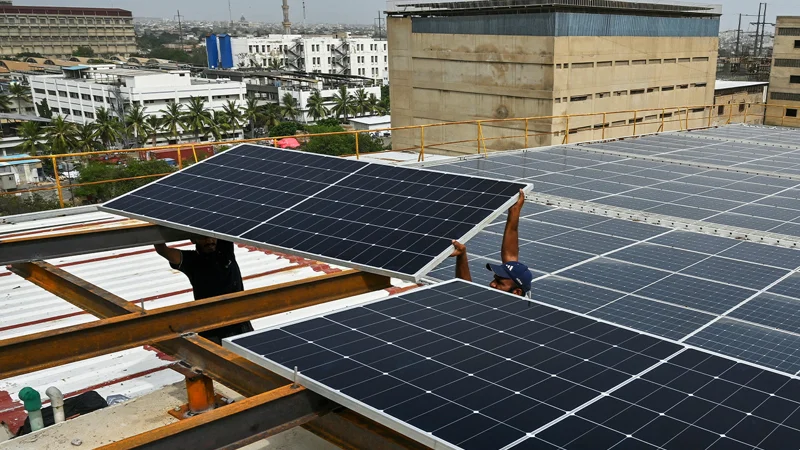
Pakistan has emerged as a major destination for Chinese solar panels as households, businesses and industries seek alternatives to expensive grid electricity.
Ember’s Global Electricity Review 2025 reported that Pakistan imported 17 gigawatts of solar panels in 2024, roughly double the previous year’s volume.
Other figures illustrate the scale of this dependence. Data cited in the supplied report show that Pakistan imported about 3,500 megawatts of Chinese solar components in 2022. The volume rose to approximately 16,600 megawatts in 2024.
Ember data cited in the report put Pakistan’s Chinese panel imports at around 16.86 gigawatts in 2025. That figure made Pakistan the second-largest importer of Chinese solar panels that year.
Pakistan accounted for approximately 12% of China’s solar exports in 2025, compared with 2% in 2022, according to the supplied figures.
These estimates vary by year and measurement method. Nevertheless, they underline Pakistan’s exposure to changes in Chinese solar manufacturing policy.
Solar Power Has Reshaped Pakistan’s Electricity Market
The rapid expansion of solar power has changed Pakistan’s electricity mix. Ember reported that solar generated an average of 25.3% of Pakistan’s utility electricity during the first four months of 2025.
The figure compared with a global average of about 8% over the same period, according to the report.
Meanwhile, Renewables First estimated that cumulative solar imports from China had reached around 51.5 gigawatts by November 2025.
Official figures tell a different part of the story. Net-metered solar capacity stood at 6.8 gigawatts in September 2025. Renewables First estimated total installed solar capacity at between 27 and 33 gigawatts, including systems outside the official net-metering count.
However, Pakistan’s solar import boom has recently slowed.
According to figures cited in the supplied report, imports fell to 4,574 megawatts between January and May 2026. That represented a 61% decline from 11,781 megawatts during the same period in 2025.
The dollar value of imports also dropped by 54%, to $514 million. The report linked the slowdown to domestic market conditions and noted that battery imports were increasing.
In May, customs authorities also raised assessed values for imported solar panels ahead of the 2026–27 budget.
Power Sector Raises Concerns Over Falling Grid Demand
Pakistan’s growing solar adoption has also created challenges for electricity distribution companies. Utilities argue that solar power reduces grid sales while leaving fixed generation costs largely unchanged.
At a National Electric Power Regulatory Authority (NEPRA) hearing, distribution companies blamed solarisation for declining electricity sales. They sought a quarterly adjustment of Rs33.78 billion, most of which related to capacity charges.
The Energy Ministry also told the International Monetary Fund that solar adoption had reduced electricity demand and increased payments for idle generation capacity.
Meanwhile, the government has replaced net metering with net billing. The power minister said Pakistan had approximately 7,000 megawatts of on-grid solar capacity and more than 13,000 megawatts of off-grid capacity.
However, critics argue that solar power alone does not explain the sector’s financial problems.
The Sustainable Development Policy Institute (SDPI) has highlighted capacity payments exceeding Rs1.77 trillion in fiscal year 2025 under take-or-pay contracts. When electricity demand falls, these fixed payments become more burdensome because utilities spread them across fewer units sold.
Could China’s Restrictions Delay Local Solar Manufacturing?
The immediate impact on Pakistan’s solar supply appears limited if finished panels remain outside the proposed restrictions. The longer-term implications for domestic manufacturing, however, are less certain.
Pakistan has expressed interest in building a local solar manufacturing industry. Yet the Pakistan Solar Association has said the country lacks a large-scale facility producing high-efficiency solar panels.
SDPI has proposed developing local manufacturing through special economic zones and joint ventures with Chinese companies under the China-Pakistan Economic Corridor (CPEC).
A Chinese-backed initiative known as the “E-Cluster” follows a phased approach, beginning with completely knocked-down assembly. This model could help Pakistan establish basic manufacturing operations before moving towards more advanced production.
However, deeper localisation would require access to Chinese technology, technical expertise and production equipment. If Beijing introduces stricter licensing requirements, Pakistani manufacturers could face delays in developing domestic production of advanced cells, wafers and polysilicon.
Assembly using established module technologies may face fewer obstacles. However, the actual impact will depend on the final rules, their technical thresholds and the licences Chinese authorities grant.
The proposed controls could therefore slow Pakistan’s efforts to move beyond assembly towards advanced solar manufacturing. They do not, by themselves, establish that Pakistan’s imports of finished Chinese panels will face restrictions.
Pakistan May Need a Targeted Manufacturing Strategy
Pakistan’s dependence on Chinese solar technology presents both risks and opportunities. The country can continue importing finished panels while developing domestic manufacturing capacity, provided the proposed controls do not expand to cover those products.
However, building a competitive solar industry will require more than assembling imported components. Manufacturers will need reliable access to technology, investment, skilled workers and a stable regulatory environment.
Waqas Moosa of the Pakistan Solar Association has argued that Pakistan should focus on niche products, such as small solar modules, rather than compete directly with China’s large manufacturers.
A targeted strategy could help local businesses develop expertise in selected product segments. It could also reduce the challenge of competing with established Chinese producers across the entire solar supply chain.
Ultimately, China’s proposal highlights a distinction between importing solar panels and manufacturing them. Pakistan’s immediate access to finished modules appears less exposed than its longer-term ambitions for advanced domestic production.
The final impact will depend on the restrictions China adopts and whether Pakistani companies can secure the technology needed to expand local manufacturing.









[…] China Proposes Solar Technology Export Controls, Raising Questions for Pakistan’s Solar Industry […]