China’s humanoid robots have demonstrated remarkable speed, with some machines running faster than the fastest human sprinters. But their biggest challenge may not be athletic performance. It will be proving that they can handle practical jobs reliably.
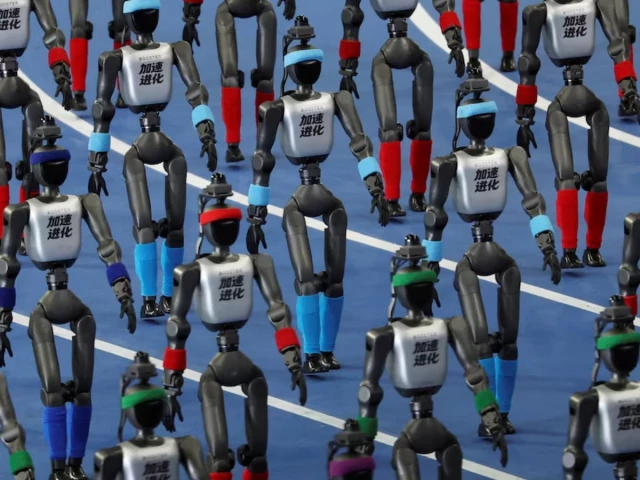
The five-day World Humanoid Robot Games began Saturday in Beijing. The event combines sports competitions with simulated workplace tasks designed to test robots in factories, restaurants, offices and emergency situations.
Organisers have included 51 events, comprising 30 sports competitions and 21 scenario-based contests. According to Huawei, more than 40% of the events require robots to operate fully autonomously.
Robots Break Sprint Records
Two humanoid robots ran the 100 metres faster than Usain Bolt’s 9.58-second world record on Saturday. The performance marked a major improvement from 2025, when the winning robot needed more than 20 seconds.
The machines still faced a practical problem: stopping. After crossing the finish line, the robots slammed into a thick safety mat placed several metres away.
Another robot from the same model family completed the 400 metres in 39.7 seconds. That was faster than South African sprinter Wayde van Niekerk’s human world record of 43.03 seconds.
Robotics investor Xu Qiaosheng said the competition had become more demanding than last year. He noted that the higher intensity would test battery management and thermal systems.
Real-World Tasks Matter More
The most important tests may involve less spectacular tasks.
Robots will compete in EV charging, restaurant operations, industrial assembly and material loading. They will also attempt cable connections that test vision, hand positioning and force control.
These challenges expose robots to the imperfections of real workplaces. A cable may sit at an unusual angle. A package may shift. An object may fall outside the expected position.
A useful robot must identify such problems, adjust its movements and recover from mistakes without constant human assistance.
Lumos Robotics CEO Yu Chao said the games could help companies improve their hardware and showcase new technology. However, he stressed that real value would come from solving practical problems.
“Only when it can work in those end scenarios does it have real value,” Yu said.
Spider-Man: Brand New Day Holds Top Spot at Box Office for Fourth Weekend
From Demonstrations to Industry
The games also feature tug-of-war, weightlifting, Tai Chi and pitch-pot competitions. These events give developers an opportunity to demonstrate improvements in movement and control.
Beijing-based robotics startup Galbot plans to stage an autonomous humanoid tennis match. The robots will attempt singles and doubles matches while tracking the ball, serving and returning shots.
However, the industry faces a bigger question after the demonstrations end: can companies sell robots that consistently solve real customer problems?
Zeroth Chief Marketing Officer Hua Rong said that will ultimately determine the competition. The key issue is whether robots can deliver useful work once customers deploy them in real environments.
For China’s rapidly developing humanoid robotics industry, speed may attract attention, but reliability, autonomy and practical usefulness will determine whether the technology becomes commercially successful.












[…] China’s Humanoid Robots Face Bigger Test Beyond Speed Records […]