/ Sep 16, 2026
Trending
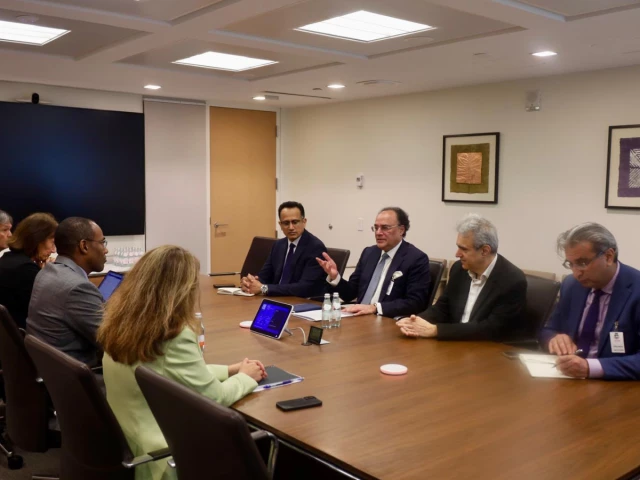
IMF officials met Finance Minister Muhammad Aurangzeb on Thursday to review Pakistan’s macroeconomic performance, assess progress under the Fund-supported reform programme and discuss the country’s ongoing structural reforms, according to the Ministry of Finance.
Aurangzeb held separate meetings with IMF First Deputy Managing Director Dan Katz, Deputy Managing Director Nigel Clarke, Middle East and Central Asia Department Director Jihad Azour, and IMF Mission Chief for Pakistan Iva Petrova.
During the discussions, the finance minister reviewed Pakistan’s implementation of the Extended Fund Facility (EFF) and the Resilience and Sustainability Facility (RSF), while highlighting the government’s broader reform agenda.
Aurangzeb said Pakistan has improved its fiscal and external balances, achieved key revenue targets, strengthened foreign exchange reserves, recorded historic remittance inflows and improved its current account position.
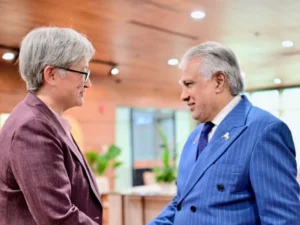
Ishaq Dar, Australia’s Penny Wong Call for Diplomacy During ASEAN Forum Talks
The meetings also focused on tax reforms, energy sector restructuring, privatisation, tariff rationalisation, debt management, financing diversification and Pakistan’s efforts to return to international capital markets.
Both sides exchanged views on long-term economic priorities, including investment in human capital, expanding women’s participation in the workforce, addressing demographic challenges, promoting technology-driven growth and accelerating private sector-led, export-oriented development.
According to the Finance Ministry, Aurangzeb thanked the IMF for recognising Pakistan’s commitment to implementing reforms and reaffirmed the government’s resolve to maintain fiscal discipline, strengthen policy credibility and continue structural reforms aimed at achieving sustainable economic growth.
Pakistan remains under a $7 billion IMF Extended Fund Facility, which requires tax reforms, spending discipline and broader economic restructuring. The programme followed a $3 billion IMF standby arrangement that helped Pakistan avoid a sovereign default in 2023.
Although the country’s economic indicators have improved, Pakistan continues to rely on IMF support, official financing and financial assistance from key partners, including China and Saudi Arabia, to maintain foreign exchange reserves.
Earlier this year, Pakistan repaid about $3.5 billion to the United Arab Emirates, while Saudi Arabia extended $3 billion in fresh financial support. The State Bank of Pakistan expects foreign exchange reserves to approach $20 billion by the end of 2026.
Earlier this week, Aurangzeb also met US Treasury Secretary Scott Bessent. According to Reuters, Pakistan has requested a $10 billion exchange stabilization facility from the United States to strengthen foreign exchange reserves, support the rupee and reduce dependence on multilateral financing.
The proposed facility would provide additional financial stability while Pakistan continues implementing IMF-backed fiscal and monetary reforms.
Analysts say such a facility would strengthen investor confidence, improve external liquidity and reinforce Pakistan’s efforts to regain access to international financial markets.
Pakistan has also expanded economic engagement with the United States in recent months through cooperation in digital finance, mining and infrastructure. These initiatives include a stablecoin agreement for cross-border payments, efforts to redevelop the Roosevelt Hotel in New York and discussions on US investment in the Reko Diq mining project.

Copyright © 2026 99News. All Rights Reserved.





[…] Finance Minister Aurangzeb Reviews Pakistan’s Reform Progress in IMF Talks […]