News Elementor – News WordPress Theme 2023. Powered By BlazeThemes.
World
Yemen Conflict: Houthis Target Saudi Arabia After Sanaa Airport Strike
July 13, 2026
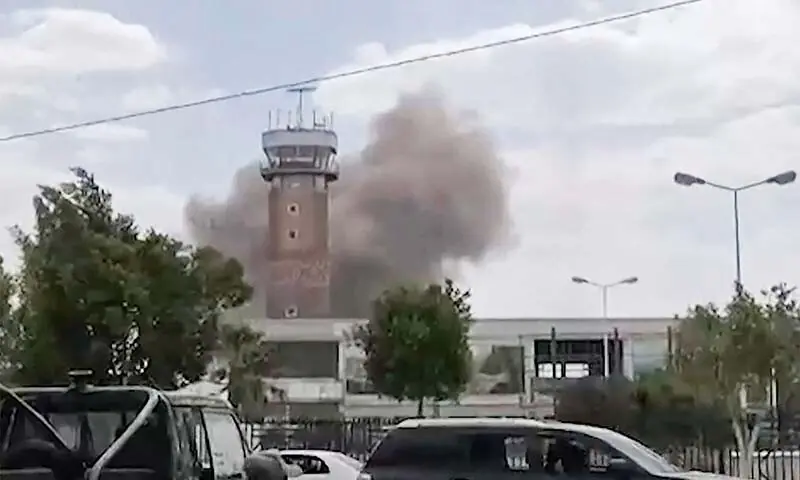
Yemen Conflict escalated sharply on Monday after Houthi rebels launched a ballistic missile towards Saudi Arabia, hours after accusing the kingdom of attacking Sanaa International Airport in the most serious confrontation between the two sides in years.
Saudi Arabia’s coalition said its air defence systems intercepted the missile targeting the country’s southern region.
Coalition spokesman Turki al-Maliki said air defences had successfully dealt with the ballistic missile launched by what he described as the terrorist Houthi militia.
Earlier, Houthi military spokesman Yahya Saree accused Saudi Arabia of ending the de-escalation phase and warned that the airport strike would not go unanswered.
The Saudi-backed Yemeni government claimed responsibility for targeting the runway at Sanaa International Airport, saying it acted to prevent an Iranian aircraft from landing.
Government officials said they took action after a Houthi delegation returning from Tehran, where it attended the funeral of Iran’s late Supreme Leader Ali Khamenei, refused to travel on Yemen’s national carrier, Yemenia.
Yemen’s Defence Ministry accused the Houthis of allowing an Iranian aircraft to violate Yemeni airspace, saying the runway was targeted to prevent the landing.
Following the strike, Presidential Leadership Council Chairman Rashad al-Alimi said he had ordered that the confrontation should not expand further.
Iran condemned the attack on Sanaa airport, with Foreign Ministry spokesman Esmaeil Baghaei describing it as a clear violation of international law.
The latest escalation has raised concerns that the fragile truce reached in 2022 could collapse, particularly as regional tensions continue to rise following recent military exchanges between the United States and Iran.
Mohammed al-Basha, founder of the US-based Basha Report risk advisory firm, warned that continued retaliation by both sides could effectively end the ceasefire framework and push Yemen back into a broader military conflict.
He said developments in the coming days, particularly regarding Iranian flights to Sanaa, would determine whether both sides return to sustained fighting.
For more than a decade, aircraft entering Yemeni airspace have required prior approval from the Saudi-led coalition, which says it enforces the restriction on behalf of Yemen’s internationally recognised government.
The Houthis have recently challenged that arrangement by organising direct flights between Iran and Sanaa, increasing tensions with both the Yemeni government and Saudi Arabia.
Earlier this month, the rebels accused Saudi Arabia of attacking another Iranian aircraft after it landed in Sanaa and departed with the Houthi delegation. They warned at the time that any further attacks would prompt strikes on Saudi airports and strategic infrastructure.
Security analyst Andreas Krieg of King’s College London said it was technically possible for the Yemeni government to carry out the airport strike using aircraft supplied by the United Arab Emirates, although such operations would present logistical challenges because of the ageing condition of its fleet.
The renewed fighting has also heightened concerns among civilians living in Houthi-controlled areas. Residents fear another cycle of conflict could deepen Yemen’s humanitarian crisis without producing a political solution.
The Yemeni government also accused the Houthis of preventing an International Committee of the Red Cross aircraft from departing Sanaa airport and temporarily holding its pilot and co-pilot.
The International Committee of the Red Cross later confirmed that all of its staff and the aircraft crew were safe and accounted for.
The Houthis have controlled Yemen’s capital, Sanaa, and much of northern Yemen since 2014. The conflict has killed hundreds of thousands of people and remains one of the world’s worst humanitarian crises.