/ Oct 14, 2026
Trending
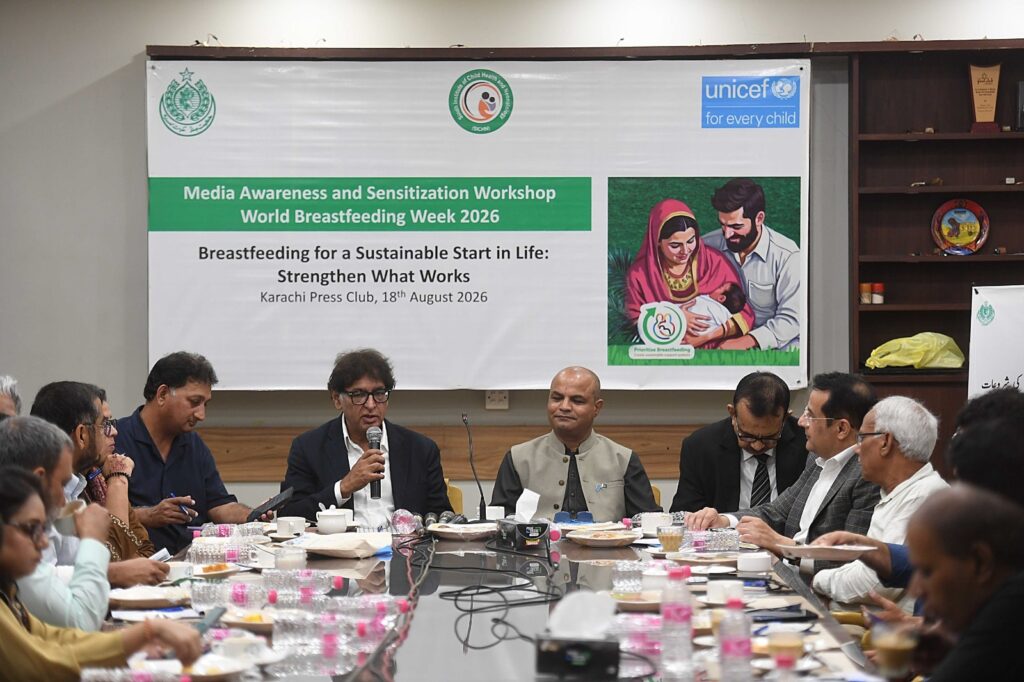
Only around 20 percent of newborns in Pakistan receive breastmilk within their first hour of life. Health experts say weak support from families, healthcare facilities and workplaces is putting infants at greater risk.
Experts shared the figures on Tuesday at a media awareness workshop in Karachi. They warned that poor breastfeeding practices contribute to thousands of preventable child deaths each year.
The workshop took place at the Karachi Press Club. The Sindh Institute of Child Health and Neonatology (SICHN) organised the event with UNICEF and the Sindh Health Department.
Data presented at the workshop linked inadequate breastfeeding to around 33,700 child deaths in Pakistan each year. Diarrhoea and pneumonia remain among the main preventable causes.
Prof Syed Jamal Raza, Executive Director of SICHN, said breastfeeding does not depend on mothers alone. He called for support from fathers, grandparents, doctors and nurses.
Sindh’s New Teacher Attendance System Stumbles on First Day in Karachi
Employers and community leaders also have a role to play. Policymakers, he said, must create stronger systems to support breastfeeding mothers.
Prof Raza said non-breastfed infants under six months face a much higher risk of death. Their estimated risk is 15 times higher than that of exclusively breastfed babies.
Partially breastfed infants also face greater risks. Their estimated risk is about three times higher than that of exclusively breastfed infants.
Only 48 percent of Pakistani infants under six months receive exclusive breastfeeding. The figure comes from National Nutrition Survey and UNICEF country-profile data cited at the workshop.
The workshop also highlighted a sharp increase in bottle-feeding among young children.
Prof Raza said bottle-feeding among children under two rose from 32 percent in 2006-07. It reached 41 percent in 2012-13 and 48 percent in 2024.
Experts warned that bottle-feeding can create health risks when families lack safe water and proper hygiene. Contaminated bottles and feeding equipment can expose infants to infections.
Incorrect preparation can also reduce the nutritional value of feeds. Other inappropriate feeding practices may create additional risks for young children.
Poor breastfeeding practices also carry a major economic cost for Pakistan.
Prof Raza’s presentation estimated annual economic losses of around $2.8 billion. Spending on breastmilk substitutes exceeds $888 million each year.
The presentation also showed the potential benefits of improving breastfeeding rates.
Increasing exclusive breastfeeding from around 48 percent to 60-70 percent could prevent between 7,600 and 14,100 child deaths every year.
It could also prevent an estimated 1.5 million to 2.8 million cases of diarrhoea annually.
Prof Raza said mothers should start breastfeeding within one hour of giving birth. Newborns should receive only breastmilk during their first six months.
He advised against giving babies water, formula or other foods unless doctors recommend them for medical reasons.
Breastfeeding should continue until two years of age or beyond. Mothers should introduce suitable complementary foods after six months.
Dr Muhammad Khalid Shafi briefed participants about the Sindh Protection and Promotion of Breastfeeding and Young Child Nutrition Act, 2023.
He said the law aims to protect breastfeeding and regulate the promotion of designated breastmilk substitutes.
The legislation covers products intended for children up to 36 months. It also restricts direct promotion, cross-promotion and sponsorship involving designated products.
The law places further limits on certain interactions between companies and healthcare professionals or the public.
Dr Shafi said authorities can process complaints through mechanisms established under the law and its rules.
The Infant and Young Child Nutrition Board oversees implementation and monitoring. It also handles complaints and decisions involving warnings or penalties, subject to due process.
Prem Bahadur Chand, Chief of UNICEF’s Field Office for Sindh, said misinformation and social pressure often discourage mothers from breastfeeding.
He also pointed to weak support systems. Chand urged journalists to provide accurate and sensitive coverage of breastfeeding issues.
Prof Dr Halima Yasmeen, Chairperson of Obstetrics and Gynaecology at JPMC/JSMU, said women need counselling before and after childbirth.
She also called for stronger support from families and employers.
Dr Mazhar Iqbal of UNICEF highlighted the importance of a “warm chain” of support. He said healthcare workers, families, workplaces and communities should work together.
M. Waqar Bhatti, a senior health and environment journalist, moderated the discussion. He said sustained media coverage could help make breastfeeding a public-health priority.
Experts agreed that improving breastfeeding rates requires more than educating mothers. Families, healthcare providers, employers and policymakers must all play their part.











[…] Pakistan’s Breastfeeding Rates Raise Alarm as Bottle-Feeding Climbs […]