Pakistan inflation rose 9.29% year-on-year during the week ending August 4, official data showed on Friday. Higher prices for edible oil and wheat flour contributed to the increase.
The Sensitive Price Indicator (SPI), which tracks short-term price movements, also rose 0.28% from the previous week, according to the Pakistan Bureau of Statistics.
Higher petroleum prices have added pressure to household budgets. Rising fuel costs have increased transport expenses and pushed up the prices of several essential goods.
Government Reviews Inflation
The National Price Monitoring Committee reviewed the latest inflation trends under the leadership of Planning Minister Ahsan Iqbal.
The committee noted that monthly inflation had slowed.
Iqbal also ordered a nationwide survey of loose edible oil, ghee and milk. The move follows concerns over food quality and the rise of cardiovascular and other non-communicable diseases.
The government plans to examine the quality of these products in different parts of the country.
Officials will also identify regional differences and investigate the causes of poor quality.
36% Packaged Food Samples Fail Tests
The Ministry of Science and Technology presented a quality assessment report to the committee.
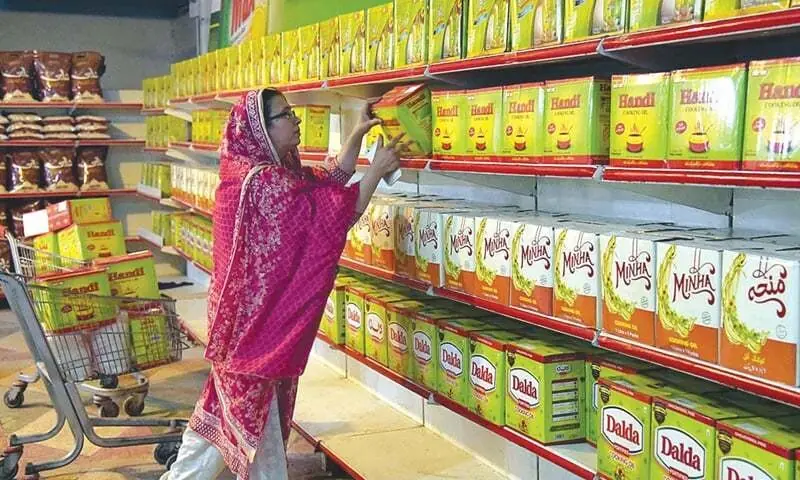
The Pakistan Council of Scientific and Industrial Research (PCSIR) collected and tested 491 samples of packaged edible oil, ghee and milk.
Pakistan Standards and Quality Control Authority (PSQCA) received the combined findings.
The results showed that 315 samples met national quality standards. However, 176 samples failed to meet the required specifications.
The failed samples represented about 36% of the total.
The report found problems across several product categories.
Of 204 banaspati ghee samples, 98 failed to meet the required standards.
Among blended cooking oils, 40 of 146 samples failed the tests.
The testing also found that 26 of 104 packaged liquid milk samples did not meet the required standards.
David Fincher’s Squid Game Spin-Off Reportedly Shelved by Netflix
Eight of 18 milk powder samples also failed.
Three of four refined palm oil samples failed to meet the standards. One of 13 refined canola oil samples also failed.
Government Orders Loose Food Survey
The committee formed a technical subcommittee to examine the laboratory findings.
The group will review the evidence and submit recommendations for regulatory action.
Iqbal directed authorities to focus the next phase on loose edible oil, ghee and milk.
These products did not form part of the earlier laboratory testing.
The planning minister instructed provincial governments and relevant authorities to conduct a nationwide survey.
Officials will assess product quality, identify regional patterns and determine the reasons for quality problems.
The survey will also recommend measures to improve food safety, regulation and consumer protection.
Gas Remains Major Inflation Driver
The committee also reviewed the country’s wider inflation outlook.
Officials examined weekly and monthly price movements. They also reviewed wholesale and retail price gaps, domestic and international commodity prices, LPG prices and progress on earlier decisions.
The committee was told that natural gas remained the largest contributor to inflation.
Housing costs, wheat flour, fresh milk and petrol also continued to push prices higher.
Lower prices for sugar, potatoes and chicken provided some relief.
Officials also reviewed global commodity prices to assess their possible impact on Pakistan’s domestic market.
Onions and Chicken See Sharpest Weekly Rise
Several essential items recorded notable price increases during the week.
Onion prices rose 10.14%. Chicken prices increased 9.19%.
Pulse gram prices went up 2.43%. Chilli powder rose 1.01%.
Mustard oil increased 0.99%, while Lipton tea rose 0.57%.
Wheat flour prices increased 0.52%. Vegetable ghee in the 1kg category rose 0.37%.
Firewood prices increased 0.32%, while washing soap rose 0.08%.
Some items became cheaper during the week.
Tomato prices fell 6.82%. LPG prices declined 1.90%.
Diesel prices dropped 1.66%, while banana prices fell 1.20%.
Petrol prices declined 0.63%. Sugar prices dropped 0.51%.
Plain bread prices fell 0.29%.
Eggs and potatoes each recorded a 0.09% decline.
The latest figures highlight continued pressure on household spending. The government’s food quality survey will now add another layer to its efforts to address rising prices and consumer concerns.










[…] Pakistan Inflation Rises 9.29% as Food and Fuel Costs Push Prices Higher […]