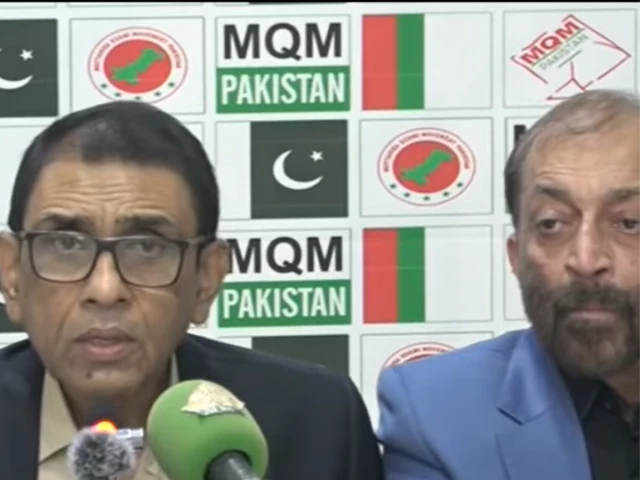
KARACHI: The Muttahida Qaumi Movement-Pakistan (MQM-P) on Sunday announced plans to launch a national dialogue on new provinces and administrative units, arguing that Pakistan’s growing population, weak governance and concentration of political power have made administrative devolution necessary.
MQM-P Chairman Khalid Maqbool Siddiqui said the party would approach political parties across the country to build consensus on creating provinces and administrative units based on population. He said the issue would remain central to the party’s future political campaign.
“There is a need for a major national dialogue, and we are going to initiate it,” Siddiqui said at a press conference in Karachi.
He argued that Pakistan’s population had grown dramatically since independence while the country still had only four provinces. According to Siddiqui, the creation of additional divisions had not kept pace with population growth, making a new administrative structure necessary.
Siddiqui said the MQM-P would also campaign for the implementation of Article 140-A, which requires provinces to establish local governments and devolve political, administrative and financial authority to elected representatives.
He said the party would approach the Supreme Court again over what it considers the failure to implement Article 140-A. Siddiqui added that MQM-P had already consulted lawyers and would seek further legal advice before approaching the court.
The MQM-P chairman also said the party had introduced a constitutional amendment bill concerning the creation of new provinces in the National Assembly. He said the bill had been referred to a standing committee and had not been rejected.
Focus on Sindh’s administrative structure
Federal Health Minister and MQM-P leader Mustafa Kamal said the party’s proposal for new administrative units in Sindh was not aimed at dividing the province or targeting Sindhis.
“Creating administrative units is not against Sindhis; it is for Sindhis,” Kamal said.
He argued that Karachi and Hyderabad represented a significant share of Sindh’s population but lacked sufficient political control over their own affairs. He said greater administrative autonomy could allow local governments to address problems involving water supply, sanitation, waste management and other public services.
Kamal also criticised the distribution and use of provincial resources, arguing that the concentration of authority at the provincial level had contributed to poor governance.
He stressed that the proposed reforms would not transfer territory between provinces.
“Not an inch of Sindh’s land is going into another province, and not an inch of another province is being brought into Sindh,” he said, describing the proposal as an administrative arrangement rather than a geographical division.
Supreme Court Calls Violence Over Khula an ‘Attack on the Constitution’
MQM-P leader Farooq Sattar said additional administrative units were essential for Pakistan’s development and stability. He proposed that existing divisions, including Larkana, Sukkur and Mirpur Khas, could become administrative units with elected leadership and greater control over local resources.
Sattar argued that stronger local governance would make elected officials more accountable to residents and reduce the concentration of authority in provincial capitals.
He also criticised what he described as entrenched feudal and hereditary political structures in Sindh, arguing that administrative devolution could give communities greater control over development and public services.
Sindh government rejects MQM-P proposal
Sindh Information Minister Nasir Hussain Shah rejected the MQM-P’s demand, saying the proposal reflected the party’s political frustration and isolation.
Shah argued that MQM-P leaders no longer represented Karachi’s political interests and accused the party of attempting to politicise the city’s economic and social affairs.
Rejecting the proposal to create new provinces or administrative units in Sindh, Shah said: “Sindh will not be divided.”
He also criticised Khalid Maqbool Siddiqui and Farooq Sattar, making personal remarks about the MQM-P leadership and questioning the party’s political unity.
Siddiqui, meanwhile, maintained that the party would keep its political focus on new administrative units and the implementation of Article 140-A, describing both issues as matters of national importance rather than an organisational demand.
The debate places the question of administrative devolution and stronger local governments back at the centre of Pakistan’s political discourse, particularly in Sindh, where the distribution of political authority between the provincial and local levels remains a longstanding issue.











[…] MQM-P Calls for National Dialogue on New Provinces and Stronger Local Governments […]