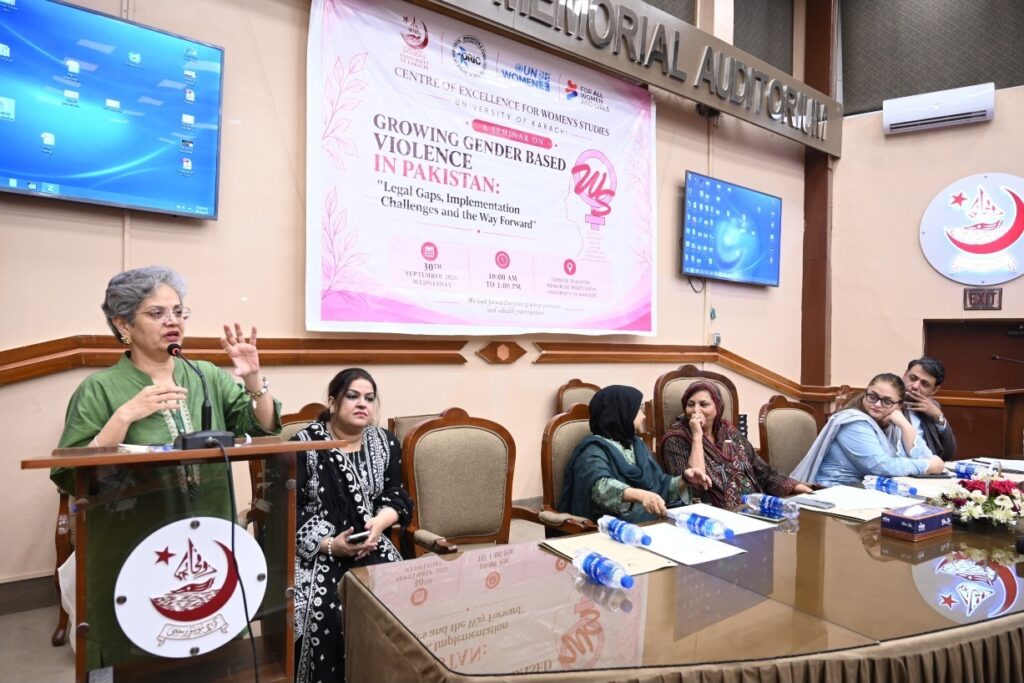
Experts at a University of Karachi seminar stressed that domestic violence extends beyond the four walls of a home.
The Centre of Excellence for Women’s Studies (CEWS), University of Karachi, organised the seminar with UN Women and the KU Office of Research, Innovation and Commercialization.
The event focused on “Growing Gender-Based Violence in Pakistan: Legal Gaps, Implementation Challenges and Way Forward.”
The seminar took place at the KU Chinese Teachers Memorial Auditorium on Wednesday.
The partnership reflected KU’s efforts to address major social issues through research, academic discussion and advocacy.
Experts also called for practical solutions to gender-based violence. They stressed that research should lead to action rather than remain within academic circles.
Domestic Violence Extends Beyond the Home
Karachi Police Surgeon Dr Summaiya Syed said violence includes more than physical assault.
She said violence can harm a person’s body, mind, reputation or property. The legal consequences can vary according to the nature and severity of an incident.
Dr Syed stressed that people should not view domestic violence as an issue limited to the home.
PAA Elects New Central Executive Committee for 2026–2028
She said close family relationships also fall within its scope. The location of an incident does not change the nature of the relationship involved.
She also highlighted the importance of the medico-legal system.
Medical teams must properly examine victims and document evidence after violence or injury. Courts can then use this evidence during legal proceedings.
Dr Syed said medical reports, police proceedings and the criminal justice system remain closely connected. Accurate documentation can therefore support the pursuit of justice.
Experts Call for Better Protection
Dr Syed said overall violence statistics can sometimes show more male deaths. However, domestic and family violence presents a different picture.
She urged authorities to consider the nature of each incident. They should also examine its background and the relationship between the victim and alleged perpetrator.
She said protecting women and children requires practical participation from society and institutions.
Dr Syed also highlighted women’s health, hygiene, safety and dignity during menstruation. She said authorities must consider the specific needs of women and children during natural disasters and emergencies.
She noted that many cases involving women and children never reach authorities.
Unreported violence makes official statistics incomplete, she said.
Dr Syed called for Child-Friendly Medical Clinics. Such facilities should provide medical care along with psychological and social rehabilitation.
She also called for effective systems to identify violence and exploitation at an early stage.
Legal Gaps Remain a Concern
Senior Council Member of the Human Rights Commission of Pakistan Mehnaz Rahman said rising violence against women and children remains alarming.
She said the actual number of gender-based violence cases is much higher than reported figures.
Rahman also expressed concern over cases involving rape and the subsequent murder of minor girls.
She said women and children face serious safety concerns even inside their homes. This situation requires stronger social and institutional protection systems.
Additional Advocate General Dr Muhammad Shahrukh Shanawaz discussed legal challenges in sexual violence cases.
He said some women seeking justice have faced accusations of adultery or fornication. Such cases can create a risk of treating victims as offenders.
He stressed that rape and fornication involve different legal requirements and provisions.
Dr Shanawaz referred to historical cases involving Safia Bibi, Tasleem Bibi, Jahan Ara and Zahra Bibi.
He said these cases showed how some women faced legal complications because of pregnancy or other circumstances rather than receiving protection after sexual violence.
He called for stronger legal safeguards for women who report sexual violence.
Social Attitudes Also Need Change
Chairperson of the Sindh Human Rights Commission Advocate Rubina Brohi spoke about the role of education and social support.
She said her father’s support allowed her to pursue education in and outside her hometown.
Brohi said her experience helped open educational opportunities for hundreds of other girls from villages.
She said people often misuse social norms against women and children. She called for a change in attitudes that allow such practices to continue.
Senior journalist Lubna Jarar Naqvi discussed the media’s role in shaping public attitudes.
She criticised the unnecessary glamorisation of crime scenes involving women and children. She said similar trends also appear in entertainment media.
Naqvi called for meaningful changes in mainstream media. She said responsible media content can help influence positive social change.
Universities Have a Key Role
KU Dean of the Faculty of Arts and Social Sciences Professor Dr Samina Saeed highlighted the role of universities in preventing violence against women.
She said gender-based violence represents a serious violation of human rights. Many incidents, however, remain unreported.
Dr Saeed said violence does not always start with physical harm.
It can begin with humiliation, boundary violations, psychological pressure, fear, online harassment or inappropriate behaviour.
She stressed that gender-based violence affects society as a whole. It should not be treated only as a women’s issue.
“Universities must, through research and education, seek effective solutions and establish safe, clear, and confidential complaint mechanisms where victims can voice grievances without fear and receive effective redress,” she said.
Dr Saeed called for active participation from students, teachers and university staff.
She said institutions must not normalise or ignore inappropriate behaviour. Timely intervention remains essential.
She also described safe campuses as part of the wider effort to build a safe society.
Experts Urge Collective Action
Earlier, KU CEWS faculty member Dr Aliyah Bilgrami said speaking out against gender-based violence remains essential.
She warned that silence can allow the problem to grow.
Dr Bilgrami called for effective legislation and stronger enforcement. She also stressed institutional cooperation, public awareness, research and collective responsibility.
Professor Dr Shagufta Nasreen said universities, research centres and media platforms must help create awareness.
She called for safe environments where victims can speak without fear or stigma.
Nasreen said silence and neglect can allow harmful patterns to continue. She stressed that collective action can help challenge such patterns.
Former KU Dean of the Faculty of Arts and Social Sciences Professor Dr Shaista Tabassum said legislation alone cannot eliminate gender-based violence.
She called for stronger enforcement, institutional cooperation and changes in cultural attitudes.
Dr Tabassum also urged researchers to turn findings into practical strategies. She said awareness campaigns should reach communities, while justice systems should protect victims.
The speakers agreed that stronger cooperation among institutions, researchers, media, government and communities remains important to address gender-based violence in Pakistan.