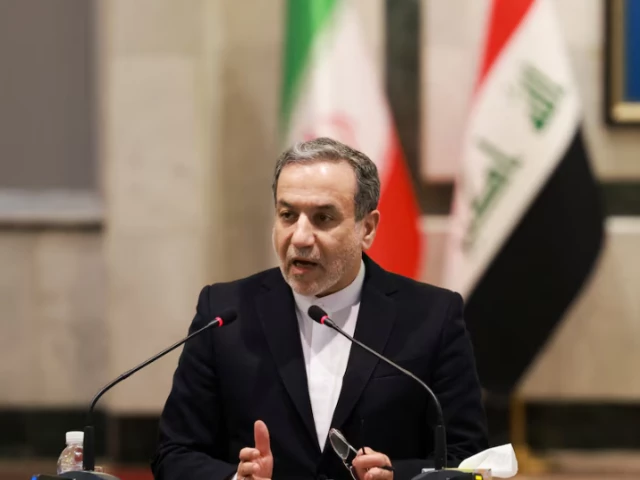
Iran has ruled out direct talks with the United States for now, saying Washington must first comply with an interim agreement reached in June. Foreign Minister Abbas Araqchi said on Sunday that Tehran and Washington were still exchanging messages through intermediaries, but no formal negotiations were taking place.
At the centre of the dispute is the Strait of Hormuz, one of the world’s most important energy shipping routes. Iran says the waterway will remain closed until the United States changes its approach and meets Tehran’s conditions.
Araqchi also said Iran and Oman were in the final stages of an agreement on alternative shipping arrangements through the strategic passage. However, he stressed that the agreement alone would not lead to an immediate reopening of the waterway.
Under the proposed arrangement, new shipping lanes would be established once Washington fulfils other conditions demanded by Tehran.
Iran’s Supreme National Security Council secretary, Mohammad Bagher Zolqadr, separately said the Strait of Hormuz would remain closed until the United States “corrects its behaviour”, according to Iranian state broadcaster IRIB.
The Islamic Revolutionary Guard Corps also reinforced Tehran’s position, saying the waterway would not reopen until Iran’s demands are accepted. IRGC spokesman Brigadier General Hossein Mohebbi accused the United States and its allies of shifting their focus towards reopening the strategic passage.
“The enemy has now put all its efforts into opening the Strait of Hormuz,” Mohebbi said, according to Iranian media. He added that Iran would maintain the closure until its conditions were accepted.
The latest developments come as tensions continue to spread across the Gulf and wider Middle East. Iranian military officials have also claimed that the United States and Israel failed to achieve their objectives during the conflict.
Brigadier General Hassan Zadeh, commander of the IRGC’s Mohammad Rasulullah Corps in Tehran, said US and Israeli leaders had failed to explain their alleged setbacks to their populations and political establishments, Tasnim reported.
He credited Iran’s military readiness and the mobilisation of the Basij forces with strengthening the country’s position in the region.
Meanwhile, Saudi Arabia said firefighting teams had extinguished a blaze at a Saudi Aramco facility in Jizan. Yemen’s Houthi movement claimed responsibility for an attack on the site, saying it had used a drone in response to alleged Saudi strikes in Yemen.
Saudi authorities said the fire caused no casualties. The Saudi Energy Ministry did not immediately attribute the incident to the Houthis.
Elsewhere, reports emerged of a powerful explosion in Saudi Arabia’s Jubail region. Regional sources said gas facilities in Jubail Industrial City had been targeted and that a fire had broken out, although the cause of the incident remained unclear.
The reported Jubail incident came as Saudi authorities confirmed the separate fire at an Aramco refinery facility in Jizan. Officials did not establish any connection between the two incidents.
The regional tensions have also triggered threats of retaliation from Iraqi armed groups. Akram al-Kaabi, leader of Harakat Hezbollah al-Nujaba, said diplomacy with Saudi Arabia would not resolve the dispute following joint US-Saudi strikes against facilities linked to Iraq’s Popular Mobilisation Forces.
He called for a military response, arguing that attacks against the group could only be answered with force.
The Pentagon, meanwhile, has urged US defence companies to accelerate weapons production as Washington faces growing pressure on its military stockpiles during the conflict with Iran.
According to a Defence Department memo cited by The Washington Post, Deputy Defence Secretary Steve Feinberg instructed defence companies to submit plans within 21 days to increase production and speed up deliveries of critical weapons and munitions.
The directive comes amid reports of shortages involving several types of US munitions, including Patriot missile interceptors.
President Donald Trump has maintained that the United States has large quantities of weapons available, saying additional supplies are being manufactured and shipped as required.
The dispute over the waterway remains one of the biggest obstacles to restoring normal energy shipments. Before the conflict, the Strait of Hormuz carried roughly one-fifth of global oil and gas shipments, making its disruption a major concern for international energy markets.
Iran says reopening the passage depends on Washington meeting a broader list of demands, including an end to US threats and military action, the lifting of sanctions and blockades, and the release of Iranian assets.
Oman has described its discussions with Tehran as positive and constructive while urging all sides to avoid actions that could undermine the negotiations.
Oman’s Foreign Ministry also condemned repeated attacks on vessels travelling through the waterway but did not assign responsibility for the incidents.
Araqchi said the previous traffic separation system was no longer acceptable to Tehran. Iran and Oman are therefore discussing a temporary shipping route while technical and legal arrangements for a permanent system are worked out.
Meta Faces $567m Penalty as New Mexico Court Orders Tougher Child Safety Rules
Iranian President Masoud Pezeshkian has expressed support for an agreement, saying the country has demonstrated unity and strength during the conflict.
At the same time, shipping remains under pressure. The United Arab Emirates said Iran had struck a vessel linked to its state oil company with a missile while it was travelling through the waterway. No injuries were reported.
The UK Maritime Trade Operations agency also reported that a vessel caught fire after being hit by an unidentified projectile. The blaze was later extinguished, with no environmental damage reported.
US Central Command said it had allowed more than 30 vessels carrying humanitarian aid to pass since the blockade began, while claiming that its forces had turned away dozens of other ships and disabled or boarded several vessels.
The prolonged disruption has also increased economic pressure inside Iran. Food and other essential goods have become significantly more expensive since the conflict began, with Pezeshkian blaming US actions for difficulties in importing basic supplies.
Despite diplomatic efforts involving Oman, Tehran continues to insist that the waterway will not reopen until Washington accepts its conditions. The position leaves the future of one of the world’s most important energy routes closely tied to the broader US-Iran confrontation.








[…] Iran Keeps Hormuz Closed as US Tensions Rise Across Gulf Region […]