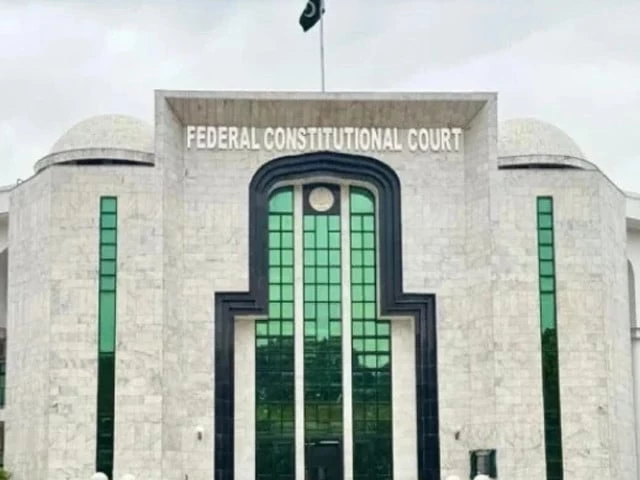
ISLAMABAD, September 29, 2026: The Federal Constitutional Court (FCC) has narrowed the scope of actionable workplace harassment under the Protection against Harassment of Women at the Workplace Act, 2010.
The court held that inappropriate or objectionable workplace conduct does not become actionable under the law unless it has a sexual element.
A three-member FCC bench headed by Chief Justice Amin-ud-Din Khan delivered the ruling.
Justice Ali Baqar Najafi authored the judgment. Justice Syed Arshad Hussain Shah was also part of the bench.
The court set aside an Islamabad High Court judgment in a case involving a female employee of the National Bank of Pakistan.
It also restored the order passed by the President in the harassment matter.
FCC Defines Scope of Harassment Law
The FCC said workplace behaviour may generally be described as harassment.
However, such conduct does not become actionable under the 2010 Act without a sexual dimension.
The court noted that misconduct can have serious consequences.
It can also create an unpleasant or harmful workplace environment.
However, such conduct alone does not bring a complaint within the ombudsperson’s jurisdiction under the Act.
The judgment also distinguished workplace misconduct from sexual harassment.
It said departmental disciplinary proceedings could apply when conduct amounts to misconduct but lacks the required sexual element.
Five Terrorists Killed in Khyber’s Bara IBO, Sources Say
Court Refers to Section 2(h)
The bench examined Section 2(h) of the Protection against Harassment of Women at the Workplace Act.
The court noted that the preamble uses the broader term “harassment”.
However, it said the statutory definition in Section 2(h) determines the conduct covered by the law.
The FCC therefore held that sexual conduct remains a necessary element for harassment to become actionable before the ombudsperson.
The court said the law protects both women and men from workplace harassment with a sexual dimension.
FCC Takes Different View From Supreme Court
The ruling differs from a broader interpretation previously adopted by the Supreme Court.
In a 2025 judgment, the Supreme Court recognised that workplace harassment could include gender-based discrimination and a hostile work environment.
That interpretation placed emphasis on power, control and domination rather than sexual desire alone.
The FCC has now taken a narrower view of the statutory definition.
It held that gender-based sexual discrimination can fall within the Act when the required sexual element is present.
Ordinary misconduct without that element may instead lead to departmental action.
Case Involved National Bank Employee
The case involved Nadia Sarwar, an employee of the National Bank of Pakistan.
The appeals were filed by Usman Shahid and Aqeel Abbas.
The FCC allowed their petitions and set aside the Islamabad High Court’s decision.
The Islamabad High Court had earlier restored the Federal Ombudsman’s 2013 decision.
That decision had imposed the major penalty of compulsory retirement under the relevant provisions of the harassment law.
The FCC’s ruling has now changed the legal position in that particular case.
The judgment draws a clear distinction between sexual harassment covered by the 2010 Act and other forms of workplace misconduct.