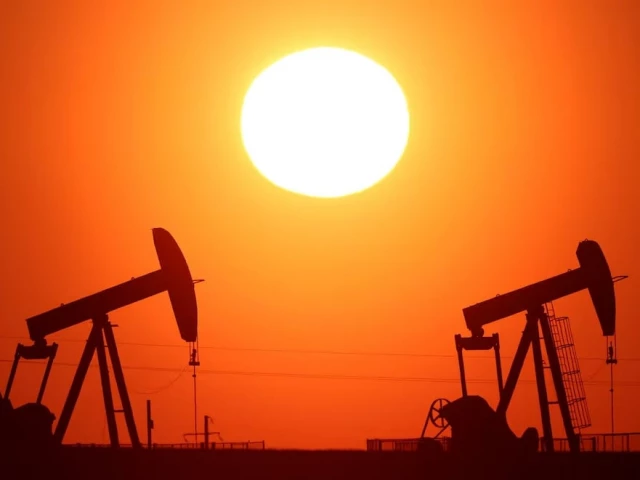
Oil prices slipped on Thursday after several sessions of gains as investors weighed weaker global demand forecasts against the continued uncertainty surrounding the Strait of Hormuz.
Brent crude futures fell 42 cents, or 0.47%, to $88.56 a barrel. The decline came after six consecutive sessions of gains.
US West Texas Intermediate (WTI) crude dropped 55 cents, or 0.66%, to $82.72 a barrel after rising for five straight sessions.
The market has remained sensitive to developments between the United States and Iran. However, a senior Iranian source said on Wednesday that talks to revive an interim agreement reached in June had made no progress.
ING analysts said the two sides remained deadlocked, leaving traders without a clear path toward reopening the strategic waterway.
The lack of progress has helped keep oil prices elevated. The Strait of Hormuz remains a crucial route for global energy shipments, making any prolonged disruption a major concern for oil markets.
Trump’s Vaccine Order Faces Scrutiny as Experts Challenge Claims About Childhood Shots
At the same time, traders have shifted their attention toward demand after fresh data showed a sharp increase in US crude inventories.
US commercial crude stocks rose by 17.4 million barrels during the week ended August 7, according to the Energy Information Administration. The increase pushed total inventories to 424.4 million barrels, their highest level since June 5.
The build was significantly larger than analysts had expected. A Reuters poll had forecast a decline of about 1.4 million barrels.
The increase also marked the largest weekly rise in US crude inventories since January 2023.
OPEC and IEA cut demand outlook
The latest inventory data added to concerns about weaker oil consumption.
The Organisation of the Petroleum Exporting Countries lowered its forecast for global oil demand growth in 2026 to 580,000 barrels per day in its latest monthly report.
The International Energy Agency took an even more cautious view. It now expects global oil consumption to contract by 1.6 million barrels per day this year.
That forecast compares with the IEA’s previous estimate of a 1 million barrel-per-day decline.
The agency said higher prices and restricted supplies linked to the US-Israeli war with Iran could further weaken consumption.
Hormuz uncertainty supports prices
Despite the weaker demand outlook, geopolitical tensions continue to provide support for crude prices.
The Strait of Hormuz remains a central concern for traders because disruptions there could affect the movement of oil and other energy supplies.
Shipping conditions have also become more difficult. Analysts at Haitong Futures said deteriorating maritime security had forced some vessels to switch off their tracking signals.
That has made it harder for the market to assess the number of vessels moving through the region and determine the actual level of available supplies.
Meanwhile, a major drone attack on Russia’s Novorossiysk port appears to have avoided the site’s oil infrastructure. There were no immediate reports of damage to oil terminals.
For now, traders are balancing two competing forces: geopolitical risks that could restrict supplies and growing evidence that weaker demand may limit further price gains.
With US-Iran talks still stalled and the Strait of Hormuz yet to reopen, oil markets are likely to remain highly sensitive to any developments affecting global energy flows.










[…] Oil Prices Ease After Six-Day Rally as Hormuz Deadlock Keeps Markets on Edge […]