/ Sep 16, 2026
Trending
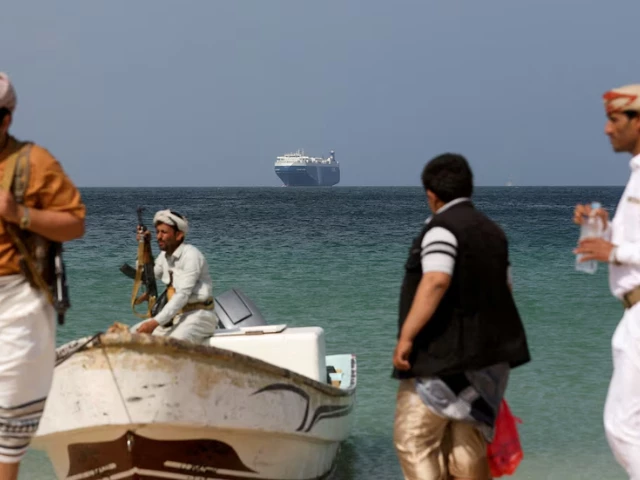
Red Sea tensions intensified on Thursday after Yemen’s Houthi movement claimed missile and drone attacks on two Saudi oil tankers, while the United States launched another round of strikes on Iran, heightening concerns over regional security and global energy supplies.
The Houthis said they targeted the Saudi tankers Encelia and Layla as part of what they described as a naval blockade against Saudi Arabia. The group controls territory near the Bab el-Mandeb Strait, a strategic shipping route linking the Red Sea to the Gulf of Aden.
Saudi state news agency SPA confirmed that the Encelia sustained damage after a strike triggered a fire at the vessel’s bow. Officials did not immediately confirm the reported attack on the Layla.
A maritime security source said the Encelia transmitted a distress signal after a missile struck the tanker near the Saudi port of Jizan late on Wednesday.
Misha Japanwala Creates Sculptural Designs for Christopher Nolan’s The Odyssey
The Houthi blockade threatens to create another major bottleneck for global energy shipments alongside Iran’s restrictions around the Strait of Hormuz. Shipping data showed that five oil tankers changed course to avoid the Bab el-Mandeb Strait, while three Saudi oil tankers carrying crude to China and India turned back earlier this week.
Meanwhile, the US military carried out a 12th consecutive night of strikes on Iran under orders from President Donald Trump. US Central Command said the operations aim to reduce Iran’s ability to threaten international shipping and regional security.
Iran warned that continued US attacks on its infrastructure would trigger new military responses. Brigadier General Amir Mohammad Akraminia said Iranian forces would adopt new strategies to make the conflict increasingly difficult for what he described as the aggressors.
Iran’s Islamic Revolutionary Guard Corps (IRGC) also claimed missile and drone attacks against US military assets in Jordan and Kuwait. The group said it targeted missile defence systems, military facilities, drone infrastructure and fuel depots. Jordanian and Kuwaiti authorities did not immediately confirm the claims.
The US government issued a worldwide security alert advising American citizens to exercise increased caution because of rising tensions across the Middle East. Washington also warned that Iranian-affiliated cyber groups continue to target critical infrastructure and internet-connected systems.
The United Nations World Food Programme warned that Bangladesh could face a severe fertiliser shortage after disruptions to shipping through the Strait of Hormuz pushed urea prices about 50% higher. The agency said prolonged supply disruptions could worsen food insecurity for millions of people.
President Trump warned that the United States would target Iranian infrastructure if Tehran continued attacking shipping in the Strait of Hormuz. In response, Iran threatened to strike regional oil, gas and electricity facilities and vowed to prevent oil exports if attacks on its infrastructure continued.
Iranian media also reported fresh US strikes near Bushehr, home to the country’s only operational nuclear power plant, and at the Shalamcheh border crossing near Iraq. Iranian officials said two people were killed and at least 11 others were injured in the latest attacks.
Oil markets reacted sharply to the escalating conflict. Brent crude climbed to $96 per barrel, its highest level in more than two months, while US West Texas Intermediate (WTI) crude rose to $88.27 per barrel as investors weighed the risk of further disruptions to global energy supplies.
The growing confrontation has intensified fears of a wider regional conflict that could threaten international trade routes, disrupt oil exports and place additional pressure on the global economy.

Copyright © 2026 99News. All Rights Reserved.








[…] Red Sea Tensions Deepen as Houthis Target Saudi Oil Tankers and US Expands Iran Strikes […]