/ Sep 17, 2026
Trending
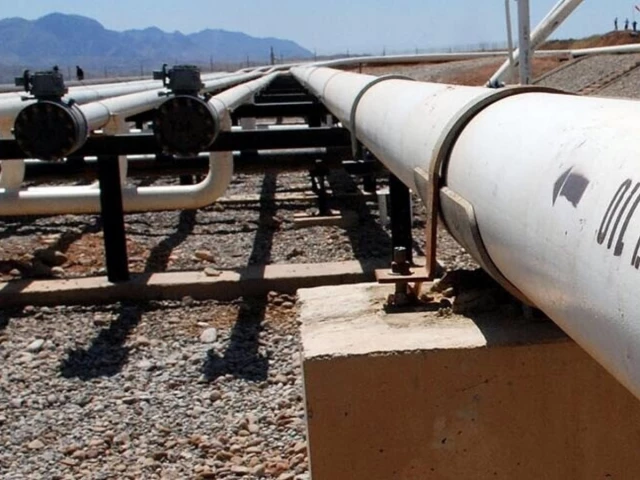
Saudi Arabia has temporarily shut down its vital East-West oil pipeline after drone strikes hit facilities in the Riyadh and Medina regions.
The Saudi Energy Ministry said several drones targeted the pipeline on Thursday morning. Authorities then suspended operations as a precaution.
Emergency and technical teams moved to secure the affected facilities and inspect the system. The ministry said it would provide further updates as they became available.
Meanwhile, Saudi Arabia’s Foreign Ministry said the drones were launched from Iraq. The attack caused injuries and material damage, according to the ministry.
Saudi authorities have not disclosed the number of casualties. They have also not provided details about the extent of the damage or said how long the shutdown will last.
The suspension has drawn attention to the strategic role of the pipeline. The system allows Saudi Arabia to move crude from its eastern oil-producing region to the Red Sea without relying on the Strait of Hormuz.
The East-West pipeline, also known as Petroline, is one of Saudi Arabia’s main crude transportation systems.
Saudi Aramco operates the pipeline. It stretches about 1,200 kilometres from Abqaiq in the Eastern Province to Yanbu on the Red Sea coast.
The entire system runs inside Saudi Arabia. It does not cross an international border.
However, its importance goes beyond domestic crude transportation. The pipeline connects Saudi Arabia’s major production and processing facilities in the east with refineries, storage sites and export terminals in the west.
As a result, Saudi Arabia can move large volumes of crude to the Red Sea without sending tankers through the Strait of Hormuz.
That alternative has become increasingly important amid the current US-Iran conflict and disruption to shipping through the strategic waterway.
The Saudi Energy Ministry said in April that the East-West pipeline had a maximum pumping capacity of about 7 million barrels per day.
The announcement followed an earlier attack on one of its pumping stations. Saudi authorities attributed that attack to Iran.
The strike temporarily reduced the pipeline’s capacity by about 700,000 barrels per day. However, the ministry later said full capacity had been restored.
Aramco also said in its first-quarter 2026 results that the pipeline had been operating at its maximum capacity of 7 million barrels per day to support supplies and exports through the western coast.
According to an Aramco presentation, about 2 million barrels per day of that capacity is directed toward western-coast refineries.
Therefore, up to 5 million barrels per day could theoretically remain available for other destinations, including exports.
That figure, however, does not mean Saudi Arabia was actually exporting 5 million barrels per day through Yanbu before the latest shutdown.
Tanker-tracking data show that crude oil and condensate loadings at Yanbu remained below the pipeline’s maximum capacity.
Vortexa, a British energy analytics and maritime tracking company, estimated that Yanbu loadings reached about 3.7 million barrels per day in early September. That compared with roughly 3.2 million barrels per day in August.
Kpler, another major energy and commodity tracking company, put September loadings at around 2.9 million barrels per day. Its August estimate stood at about 1.5 million barrels per day.
The different figures reflect differences in tracking methods and calculations.
Nevertheless, both estimates indicate that actual flows through Saudi Arabia’s western coast remained below the pipeline’s theoretical 7 million-barrel-per-day capacity.
Yanbu also has storage and loading infrastructure. Therefore, pipeline capacity should not be confused with the capacity of export terminals or the amount of crude actually loaded onto tankers.
Trump Says Iran Probably Behind Saudi Oil Pipeline Attack
The pipeline’s strategic importance has increased as shipping through the Strait of Hormuz has declined.
Saudi Arabia has traditionally relied heavily on the waterway as an export route for crude. However, the current US-Iran conflict has disrupted maritime traffic in the region.
Consequently, Saudi Arabia has relied more heavily on overland transportation to move crude to Yanbu before loading it onto tankers in the Red Sea.
The US Energy Information Administration has identified the East-West pipeline as a key route that can help Saudi Arabia bypass the Strait of Hormuz during supply disruptions.
The shift has supported higher oil flows through the Red Sea. At the same time, crude and petroleum-product flows through Hormuz have fallen sharply compared with late 2025.
The pipeline has therefore become an important part of Saudi Arabia’s strategy to maintain crude exports during disruptions in the Gulf.
However, the Red Sea route also faces security risks as tensions increase around the Bab el-Mandeb Strait.
Saudi authorities described the latest suspension as a “precautionary” measure.
In practical terms, that means pumping was stopped while emergency and technical teams secured the affected sites and inspected the pipeline and related infrastructure.
The description does not necessarily mean that the pipeline suffered extensive damage. It also does not indicate how long the shutdown will continue.
The duration will depend on the location and severity of the damage.
Authorities will need to determine whether the strikes affected the pipeline itself, pumping stations, power supplies, control systems or safety equipment.
For as long as the shutdown continues, Saudi Arabia cannot use the route normally to transport crude from its eastern fields to the western coast.
However, the impact on exports cannot be measured simply by using the pipeline’s 7 million-barrel-per-day maximum capacity.
That figure represents the system’s technical capacity. It does not represent the volume that was actually moving through the pipeline when the shutdown began.
The pipeline also does not directly supply petrol or diesel to Saudi consumers. Instead, it primarily transports crude oil.
Therefore, its most important potential impact concerns Saudi Arabia’s ability to supply western-coast refineries and Red Sea export terminals.
It also affects the kingdom’s ability to use Yanbu as an alternative export route when the Strait of Hormuz faces disruption.
As of Friday evening, Saudi authorities had not provided enough information to quantify the impact.
The Energy Ministry had not disclosed the affected pumping capacity or given a timetable for restarting operations.
After the previous April attack, officials provided a specific estimate of a 700,000-barrel-per-day capacity reduction before confirming the restoration of full operations.
So far, no comparable estimate has been released for the latest attack.

Copyright © 2026 99News. All Rights Reserved.









[…] Saudi Oil Pipeline Shutdown Highlights Its Strategic Role […]