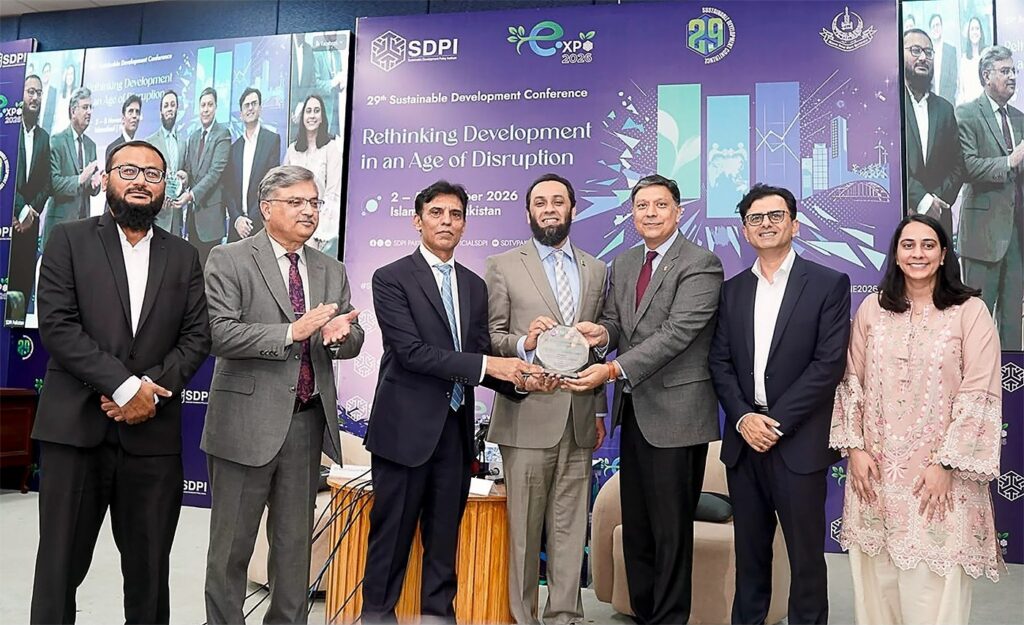
Nestlé Pakistan has won two sustainability awards at the 29th Sustainable Development Conference (SDC) and Sustainability Investment Expo (SIE) in Islamabad.
The company received recognition for Circular Economy and Resource Efficiency and Best Pavilion Presentation. The awards highlight its sustainability initiatives, regenerative agriculture efforts and work to promote circularity across its value chain.
Nestlé Pakistan also co-hosted a high-level plenary session. It focused on “Transforming Pakistan’s Agriculture and Food Systems in an Age of Disruption: AI for Regenerative and Climate-Smart Agriculture”.
Experts Discuss AI and Regenerative Agriculture
Faisal Nadeem, Head of Technical at Nestlé Pakistan, opened the discussion. He highlighted growing pressure on agricultural land and declining soil health.
“With cultivable land under increasing pressure and soil health declining, the need to transition towards regenerative agriculture has never been greater. The encouraging part is that soil health can be restored,” he said.
Nadeem added that Nestlé was working with farmers and partners. The company aims to expand practices that improve soil health and water efficiency. These efforts also seek to strengthen resilience against climate pressures.
PepsiCo Pakistan Wins Sustainability Award at 29th Development Conference
Anita Hirsch, Country Director of the World Food Programme (WFP) in Pakistan, discussed humanitarian challenges. She highlighted the impact of climate and economic disruptions.
Hirsch stressed the need to ensure food reaches vulnerable communities. She also highlighted local partnerships, artificial intelligence and supply-chain solutions. These approaches can improve food security and create more predictable income opportunities.
Nestlé Highlights Global Regenerative Agriculture Targets
Katarzyna Grzybowska, Sustainability Delivery Manager at Nestlé S.A. Global, shared the company’s international experience.
She said Nestlé aims to source 50% of its key ingredients from farmers adopting regenerative agriculture by 2030. According to her, the company has already reached about halfway towards this target.
Grzybowska stressed that regenerative agriculture must reflect local conditions. Solutions should also consider farmers’ economic needs. She called for stronger cooperation across the food system. This would help share risks and support long-term investment.
Dr Abid Qaiyum Suleri, Executive Director of the Sustainable Development Policy Institute (SDPI), highlighted Pakistan’s agricultural challenges.
He said the country’s agriculture and food systems face growing climate and economic pressures. He also highlighted the potential of artificial intelligence and smart agriculture. Stronger public-private partnerships could further accelerate the transition.
Nestlé Calls for Stronger Partnerships
Sheikh Waqar Ahmad, Head of Corporate Affairs and Sustainability at Nestlé Pakistan and Afghanistan, stressed the need for practical action.
He said resilient food systems require close cooperation with farmers. Strong partnerships can also help expand regenerative agriculture across the value chain.
Dr Zaigham Shahzad, Associate Professor at LUMS, highlighted education, research and innovation. He said these areas play an important role in strengthening Pakistan’s agricultural system.
And also discussed a recently launched certification programme with Nestlé. He described it as a step towards supporting the transition and securing agriculture’s future.
Nestlé Highlights Sustainability Initiatives Across Pakistan
Nestlé Pakistan also outlined several initiatives supporting its sustainability efforts.
The company said it is expanding regenerative agriculture practices across 125 farms. Its initiatives include 135 solar systems and 25 biogas plants.
The company is also working to improve water efficiency. Its initiatives include drip irrigation across 299 acres. Smart soil moisture sensors cover another 722 acres.
Nestlé also highlighted its Clean Gilgit-Baltistan Project. The project has facilitated the management of more than 11,000 tonnes of plastic and paper packaging waste.
The company said its sustainability initiatives support the United Nations Sustainable Development Goals (SDGs). These include SDG 13 on Climate Action, SDG 2 on Zero Hunger and SDG 12 on Responsible Consumption and Production.