ISLAMABAD: Information Minister Attaullah Tarar has alleged that Pakistan Tehreek-e-Insaf (PTI) maintained contacts with the banned Tehreek-e-Taliban Pakistan (TTP). He said the federal government would present evidence of the alleged links at a later stage.
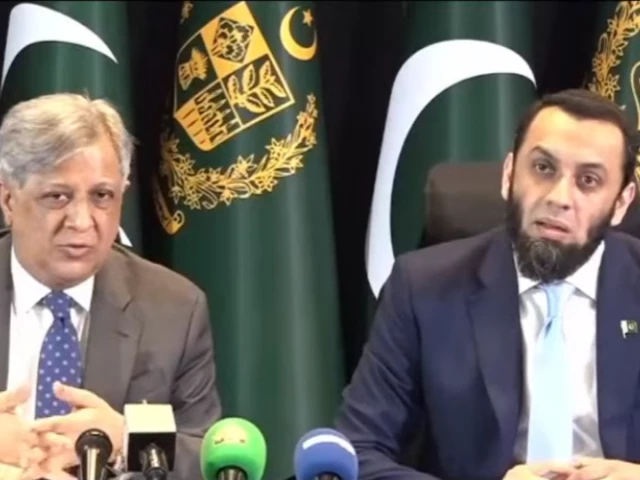
Tarar made the remarks during a briefing for foreign correspondents on Tuesday alongside Law Minister Azam Nazeer Tarar. The ministers defended the federal government’s decision to impose governor’s rule in Khyber Pakhtunkhwa (K-P), citing worsening security conditions and a failure to coordinate counter-terrorism efforts.
“The government has credible evidence that PTI was in touch with the TTP,” Attaullah Tarar said. He added that the government would soon share details of the alleged links.
Tarar accused the PTI-led provincial government of showing sympathy towards militant groups and failing to adequately support security personnel. He also alleged that the provincial administration had undermined law enforcement agencies and weakened the fight against terrorism.
The minister paid tribute to members of the armed forces, police and other security agencies who had died fighting terrorism. He said security personnel had made significant sacrifices despite what he described as insufficient provincial support.
The allegations against PTI and the provincial government were presented by the ministers during the briefing. Tarar said the government would provide further evidence concerning the alleged PTI-TTP links.
Government Cites Rise in Terrorist Attacks
Tarar said Pakistan had recorded 3,774 terrorist incidents in 2025 and 2,857 incidents up to September 2026.
He also cited an increase in fatalities, saying the number had risen from 267 in 2021 to 3,512 in 2025. He put the figure for 2026 at 2,775 at the time of the briefing.
The information minister further claimed that attacks targeting police had increased by 168 per cent. He said attackers had targeted 18 police installations over the preceding two years.
Tarar argued that the provincial government had failed to strengthen police capacity, improve security infrastructure and establish an effective counter-terrorism department.
He questioned how the province had used its financial resources, claiming it had received almost Rs800 billion through the National Finance Commission.
“Why was it not spent on creating a new CTD force, a counter-terrorism department?” he asked.
He also cited the need for Safe City surveillance cameras, forensic laboratories, police equipment and programmes to prevent violent extremism.
Tarar said he had visited Kohat after a terrorist incident, met injured people in hospital and visited the homes of those killed.
He said residents wanted authorities to eliminate terrorism because violence had damaged their lives and livelihoods. He also criticised the provincial government’s performance in education, healthcare and public service delivery.
The minister alleged that political interests and illegal economic activity had helped militant networks operate. He cited alleged cross-border smuggling involving minerals, timber, tobacco, gold and precious stones.
He also accused the provincial government of failing to ensure consistent participation in Apex Committee meetings, which coordinate counter-terrorism efforts. In addition, he raised concerns about vehicle and motorcycle registration, saying gaps in the system could complicate efforts to track their use.
Federal Government Calls for Unified Counter-Terrorism Policy
Tarar said negotiations with PTI and the K-P government had focused on security rather than political demands.
“We had only one agenda. There was no political agenda,” he said.
He argued that the federal government had sought a unified counter-terrorism policy but failed to reach an agreement with provincial authorities.
Tarar also criticised what he described as conflicting approaches towards Afghanistan. He said Islamabad had been urging Afghanistan’s interim government to prevent its territory from being used for attacks inside Pakistan.
“One country cannot have two foreign policies,” he said, calling for greater coordination between federal and provincial authorities.
The information minister alleged that the provincial government had rejected proposals for a joint strategy. He described the situation as a serious breakdown in governance and law and order.
New Administrative Structure Proposed for 12 Districts
The ministers also outlined a proposed administrative arrangement for 12 conflict-affected districts under the Area Representative and Development Council (ARDC).
Tarar said the structure would include a chairman, vice-chairman, council members and spokespersons. It would also involve an additional chief secretary and other senior officials.
He identified Yahya Akhunzada as the administrator. The proposed arrangement would include officials responsible for policing, law enforcement, narcotics control, legal affairs, tribal affairs, human rights, budgeting and revenue.
Tarar said the council would maintain regional and tribal balance to ensure local representation in security and development decisions.
“This new setup has come with new hope and has come with a renewed assurance that first and foremost law and order will be maintained,” he said.
He added that improved security would create conditions for development and allow residents of K-P to pursue greater prosperity.
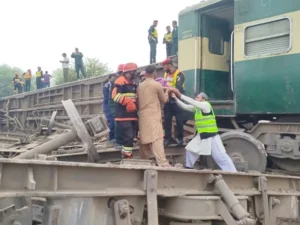
Five Killed, More Than 30 Injured as Rehman Baba Express Derails Near Multan
Law Minister Defends Constitutional Basis for Governor’s Rule
Law Minister Azam Nazeer Tarar defended the federal government’s decision, saying the cabinet had acted after consultations, negotiations with provincial authorities and a review of security reports.
He said Prime Minister Shehbaz Sharif had brought the matter before the federal cabinet. According to the law minister, the cabinet approved the decision by consensus and without dissent.
Azam said the federal government had first tried to establish a coordinated counter-terrorism strategy with the provincial authorities. However, those efforts failed to produce the desired outcome.
He referred to Articles 232 and 234 of the Constitution, which address emergency provisions and constitutional machinery in provinces.
The law minister said Article 232 dealt with emergencies involving serious internal disturbances. He also cited Article 234 in explaining the constitutional basis for presidential action when a province’s constitutional machinery fails.
According to Azam, the proclamation authorised federal intervention in provincial affairs under the relevant constitutional provisions.
He said the government had considered all available options before taking the decision. He also argued that previous elected governments had invoked similar constitutional provisions on nine or 10 occasions.
Azam said the proclamation would have to follow the constitutional approval process, including consideration by parliament. He added that Article 234 provided for a maximum period of six months.
The minister said the government had invoked both provisions because it believed the conditions for each existed simultaneously.
He described the situation in K-P as a serious failure of constitutional machinery, alongside internal disturbances that he said provincial authorities could no longer control.
Law Minister Cites Increase in Security Incidents
Azam said the government had compared terrorist-related incidents across two periods to assess the deterioration in security.
He said K-P recorded approximately 2,900 incidents between 2021 and 2024. The figure rose to around 8,600 during 2024–2026, representing an increase of approximately 195 per cent, according to his figures.
The law minister said police, armed forces personnel, customs officials and religious scholars had faced attacks. He also cited the killing of nine customs officials in a suicide attack.
Azam accused the provincial government of prioritising political activity over a coordinated response to terrorism.
He said the federal interior minister and other stakeholders had remained in contact with provincial authorities but had not secured the cooperation needed for an effective joint strategy.
The government, he added, had explored negotiations and political engagement before invoking the constitutional provisions.
“Maybe their politics was more dear to them compared to the national interest,” Azam said.
He maintained that governments should prioritise public safety and provide peaceful conditions for residents.
Minister Explains Different Approach Towards Balochistan
Responding to a question about why the government had invoked emergency provisions in K-P but not Balochistan, Azam said Islamabad had assessed the two provinces differently.
He said Balochistan’s chief minister had engaged with security agencies, visited areas affected by attacks, supported rehabilitation efforts and met injured people and bereaved families.
“Your actions speak louder than your words,” the law minister said.
He contrasted that response with what he described as inadequate action by the K-P government.
Azam expressed hope that the new administrative arrangement would improve security. However, he acknowledged that the duration of governor’s rule would depend on developments and could not be predicted with certainty.
Both ministers maintained that the federal government’s measures fell within the Constitution and aimed to restore law and order, improve coordination between security agencies and protect residents of K-P.
The government also reiterated that it would pursue its allegations concerning links between PTI and the TTP through the relevant process.









[…] Attaullah Tarar Alleges PTI Links to TTP, Defends Federal Takeover of K-P […]