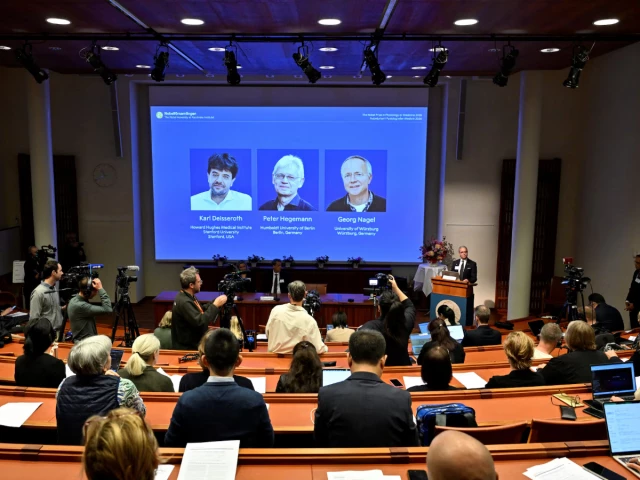
STOCKHOLM, October 5, 2026: American scientist Karl Deisseroth and German researchers Peter Hegemann and Georg Nagel have won the 2026 Nobel Prize in Physiology or Medicine for discoveries that transformed the study of the brain through optogenetics.
The Nobel Assembly at Sweden’s Karolinska Institutet selected the three scientists for their “discoveries concerning light-gated ion channels and optogenetics.” The laureates will share a prize of 12 million Swedish kronor, worth about $1.2 million.
Optogenetics Opens New Window Into the Brain
Optogenetics allows researchers to use light to control individual nerve cells in living brains. The technique has become an important tool for studying how neural activity influences behaviour and brain functions.
Thomas Perlmann, Secretary-General of the Nobel Assembly, said the method is now used in laboratories worldwide to investigate the brain.
The approach relies on light-sensitive proteins that can make nerve cells respond to specific wavelengths of light. This gives researchers much greater control over individual neurons than many traditional methods.
From Algae to Brain Research
The scientific breakthrough began with studies of the single-celled alga Chlamydomonas, which responds rapidly to light.
In the early 1990s, Hegemann investigated how the organism detects light. He proposed that a light-sensitive protein could also function as an ion channel.
Nagel later helped identify channelrhodopsin-2, a light-gated ion channel. Their work showed that the protein could be introduced into other cells and used to generate electrical activity with light.
In 2005, Deisseroth demonstrated that the technique could control nerve cells in rats. The approach soon became known as optogenetics and developed into a widely used neuroscience research method.
Potential Medical Applications
Beyond laboratory research, optogenetics is also attracting interest for medical applications.
Researchers are testing approaches that use light-sensitive proteins to restore vision in people affected by retinitis pigmentosa. Scientists are also exploring whether similar technology could improve cochlear implants by allowing more precise stimulation of the auditory nerve.
The technique could also help researchers investigate neurological and psychiatric disorders by allowing them to examine specific neural circuits with greater precision.
Laureates Surprised by Nobel Recognition
Perlmann said he spoke with all three laureates after the announcement and described them as surprised and delighted by the recognition.
The three scientists expressed particular appreciation for sharing the prize with one another, according to Perlmann.
The Physiology or Medicine prize traditionally opens the annual Nobel announcements. Awards in physics, chemistry, literature, peace and economics follow during the week.
The Nobel Prizes were established under the will of Swedish inventor and industrialist Alfred Nobel. The first awards were presented in 1901. Sweden’s central bank later established the economics prize in 1968.