China’s artificial intelligence film industry is expanding rapidly as cities compete to attract filmmakers, studios and startups developing AI-generated content.
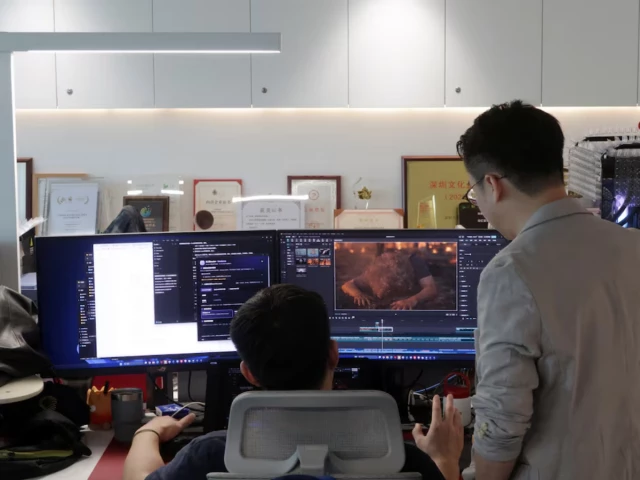
Two years ago, filmmaker Zhu Zhili saw Shenzhen as the obvious place to establish an AI film studio because of its large technology ecosystem.
Today, Zhu says officials from cities and industrial parks across China regularly contact him with offers to move or expand his business.
“I am approached every day by a range of cities, from major metropolitan areas to smaller localities,” Zhu said.
The competition reflects China’s broader effort to integrate artificial intelligence into industries ranging from manufacturing to entertainment.
Local governments are offering subsidies, computing resources, office space and other incentives to attract AI filmmakers and companies.
Shenzhen, for example, has introduced measures supporting AI-powered film, animation and micro-drama production. Its programmes include funding and technical support for qualifying digital-creative projects.
AI Cuts Film Production Costs
Filmmakers are increasingly turning to AI because it can sharply reduce production costs.
According to the figures cited in the source material, the cost of producing AI short dramas in China fell from about 5,000 yuan per minute to several hundred yuan during the first half of 2026.
AI Buildout Could Consume $10.3 Trillion in US Investment by 2032
For filmmakers, the lower costs make projects possible that would otherwise require much larger budgets.
Pan Xiaojun, a postgraduate film-directing student in Hainan, said a wedding scene that could cost around 60,000 yuan to produce traditionally cost him about 1,400 yuan using AI.
Local subsidies and rent waivers helped reduce his computing expenses further.
The cost advantage has encouraged more creators to enter the market.
Cities Compete for AI Film Businesses
Shenzhen is not alone in trying to build an AI film ecosystem.
Shanghai has introduced measures supporting AI-powered micro-dramas, including access to computing resources and cloud-based AI models.
Beijing has established a 260 million yuan fund for audiovisual technology, while its Huairou district offers computing-cost support for qualifying AI short-drama producers.
Shenzhen has also expanded support for AI video production, visual effects and content generation.
The city’s latest programmes include subsidies for qualifying AIGC micro-dramas and support for projects that achieve significant domestic or overseas distribution.
Meanwhile, major streaming platform iQIYI has increased its focus on AI-generated content and offered some creators financial support for AI productions.
Rapid Growth Raises Overcapacity Concerns
However, the rapid expansion has also raised concerns about whether the market can absorb the growing volume of AI-generated content.
DataEye figures cited in the source material show that 221,900 new AI shows appeared on Douyin during the first half of 2026.
Only 1,055 attracted more than 100 million views, a benchmark often used to identify major successes.
The figures point to a widening gap between production capacity and audience demand.
China has faced similar concerns in other industries where rapid capacity expansion has created intense competition and downward pressure on prices.
AI filmmaking could face a comparable challenge if production continues to grow faster than demand.
China Moves Toward AI Feature Films
The AI push is also moving beyond short-form online content.
In April, Bona Film Group received approval for Sanxingdui: Future Memories, a 90-minute science-fiction feature made with substantial use of AI technology.
The film received a public-screening licence from China’s National Film Administration, making it the first AI-generated feature approved for theatrical release in China, according to Caixin.
Chinese authorities currently regulate such AI-generated films through existing categories rather than a separate AI-film classification.
The development marks a significant step as Chinese studios explore how AI can contribute to full-length theatrical productions.
China has also established research and development initiatives focused on combining AI with virtual filmmaking and production technologies.
Copyright and Jobs Remain Concerns
Despite the rapid growth, AI filmmaking has generated criticism from actors, creators and audiences.
Chinese performers have raised concerns about the use of their likenesses in AI-generated productions.
The technology has also prompted concerns about copyright, voice-actor jobs and the unauthorised use of creative work.
Some audiences have criticised AI productions for plagiarism and a lack of originality.
At the same time, China requires AI-generated content to carry appropriate identification, while questions over copyright protection and ownership continue to develop.
These concerns could become more important as AI-generated films move from experimental projects into mainstream entertainment.
Chinese AI Films Look Overseas
Chinese filmmakers are also looking beyond the domestic market.
AI-generated dramas and short-form productions are increasingly being developed for international distribution.
Shenzhen has specifically encouraged qualifying digital-creative projects to reach overseas platforms, while local industry initiatives are building production and distribution networks for international markets.
Director Cao Yiwen has also showcased an AI-animated film internationally and argued that China is moving quickly to establish itself in the emerging sector.
The expansion suggests that China’s AI film strategy is no longer limited to reducing production costs.
Instead, cities and companies are seeking to build a complete ecosystem covering AI models, computing infrastructure, filmmaking talent, production studios and global distribution.
For filmmakers such as Zhu, the combination of technology and government support provides an opportunity to experiment at a scale that would have been difficult through conventional filmmaking alone.
However, the industry’s long-term success will depend on whether audiences continue to embrace AI-generated content, whether producers can develop sustainable business models and how regulators address copyright, consent and employment concerns.












[…] China’s AI Film Boom Sparks Race for Creators and Investment […]