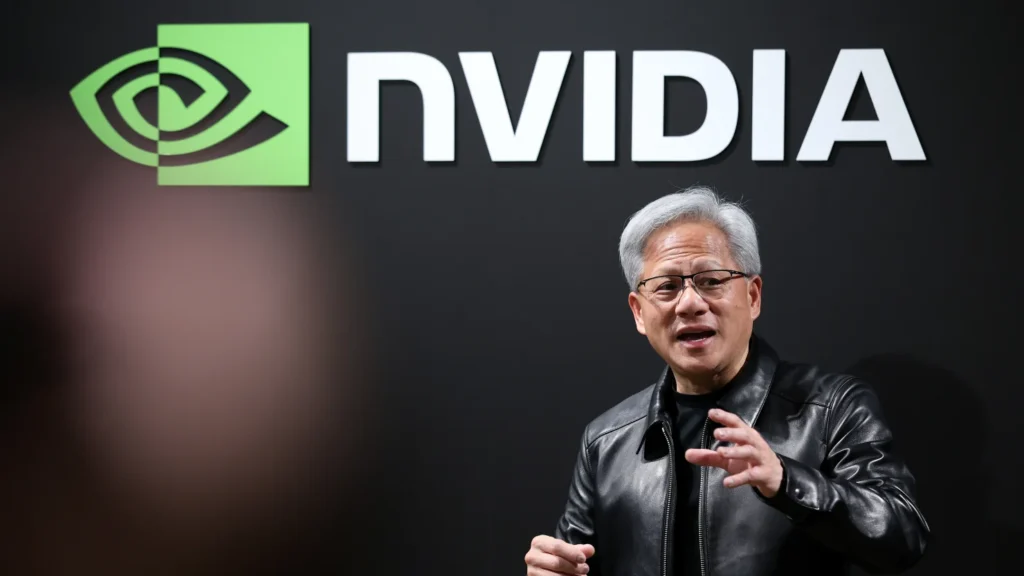
AI financing is entering a new phase as Nvidia CEO Jensen Huang brings some of Wall Street’s biggest financial institutions together to mobilise as much as $500 billion for the construction and expansion of artificial intelligence infrastructure.
Huang unveiled the initiative on Monday alongside senior executives from Goldman Sachs, BlackRock, Blackstone, KKR, Apollo and Brookfield. The firms said they are prepared to provide lending capacity of $500 billion or potentially more for new AI factories as chipmakers and major cloud companies race to expand computing capacity.
The initiative marks a potential shift in how the global AI boom will be funded. Until now, much of the enormous spending on data centres, advanced chips and AI models has been financed directly through the balance sheets of technology companies or through equity and corporate debt markets.
Huang argues that AI infrastructure has now matured into a distinct investment category because the systems generate revenue and can remain productive for years.
“These systems are not like our PCs, not like our phones,” Huang said during a CNBC interview. “These are revenue-generating assets now.”
The financing plan is based on the idea that AI computing infrastructure can be treated more like traditional productive assets than conventional consumer electronics.
Goldman Sachs CEO David Solomon said financial institutions were increasingly considering asset-based financing for AI infrastructure because the underlying facilities and equipment have tangible value.
The proposed structure could allow investors to finance AI supercomputers and data-centre infrastructure based on their expected revenue rather than relying entirely on the creditworthiness of the companies operating them.
KKR digital infrastructure chief Waldemar Szlezak said the risks associated with AI infrastructure could potentially be divided and sold to different investors, creating new financial products around the rapidly expanding technology sector.
The scale of the proposed financing reflects the enormous capital requirements facing the AI industry.
Alphabet, Amazon, Meta, Microsoft and Oracle have collectively raised more than $150 billion this year through debt and equity offerings to fund data-centre construction, AI model development and the expansion of AI-powered services.
Intel also announced a $15 billion stock offering on Monday before increasing the size of the deal to $20 billion.
The new Wall Street initiative comes as technology companies face increasing pressure to finance infrastructure expansion while continuing to invest heavily in AI research and development.
Some major technology companies have already reached the point where their spending on AI infrastructure is putting pressure on cash flow.
The proposed financing platform could therefore provide an alternative source of capital, allowing companies to build computing facilities without carrying the entire cost on their own balance sheets.
Nvidia would play a central role in the proposed structure. The chipmaker said it would have the option to backstop up to 25% of each loan, potentially helping borrowers secure more favourable financing terms.
Huang said Nvidia would also connect customers with financing partners. Companies receiving financing would be required to use Nvidia-specified system architectures designed so that another operator could take over the infrastructure if the original borrower encountered financial difficulties.
The initiative, however, remains at an early stage.
The companies have signed memorandums of understanding rather than binding contracts, leaving important questions about borrowers, interest rates, locations and construction timelines unanswered.
The scale of the proposed financing also raises questions about the risks involved in turning AI infrastructure into a financial asset class.
The comparison is particularly notable because Wall Street has previously experienced major problems when financial innovation became disconnected from the underlying economics of an asset.
During the 2007-09 financial crisis, banks and investors packaged subprime mortgages into securities that spread housing-market risk throughout the financial system. When mortgage defaults increased, those structures suffered severe losses.
Some investors have already warned that AI infrastructure could face its own challenges if technology companies overestimate the useful life of chips or underestimate depreciation.
Michael Burry, the investor who famously bet against the US housing market before the financial crisis, previously questioned whether major technology companies were accurately accounting for the useful life and depreciation of AI-related equipment.
The financial executives involved in the new initiative acknowledged that the AI investment boom will not be without failures.
“There will be excesses, there will be pullbacks,” said Jim Zelter, president of Apollo Global Management.
Solomon similarly warned that some large technology companies could fail to meet investor expectations even as others emerge as major winners from the AI expansion.
BlackRock CEO Larry Fink compared the opportunity to the early development of the mortgage-backed securities market, describing the AI infrastructure financing model as a potential new frontier for financial engineering.
Pakistan Women’s Netball Team Crush South Korea 72-23 to Boost Plate Division Hopes
Despite the risks, the financial institutions involved see significant opportunity in the scale of global AI investment.
Research firm McKinsey expects global spending on AI infrastructure to reach trillions of dollars by the end of the decade, creating demand for new sources of capital beyond traditional corporate financing.
Huang’s plan could provide that capital by connecting technology companies and infrastructure developers with some of the world’s largest pools of institutional money.
Brookfield CEO Bruce Flatt said the initiative creates a structure capable of attracting investment from the enormous amount of capital available globally.
The key question now is whether AI infrastructure can generate enough long-term revenue to justify the scale of borrowing being proposed.
If demand for AI computing continues to grow, the new financing model could accelerate the construction of data centres and computing facilities around the world.
But if AI demand, chip economics or expected returns fall short, investors could face losses across a much larger financial ecosystem.
For Nvidia and its Wall Street partners, the proposed $500 billion platform represents a major bet that AI infrastructure will evolve from a technology expense into a long-lived, income-generating asset class capable of supporting one of the largest investment cycles in modern history.











[…] AI Financing Enters New Era as Nvidia and Wall Street Target $500 Billion Buildout […]