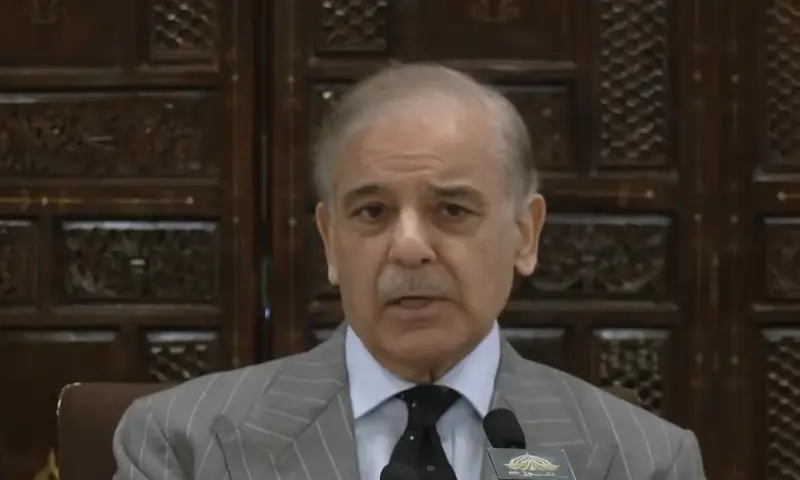
PESHAWAR, October 22, 2026: Prime Minister Shehbaz Sharif has defended the imposition of emergency and governor’s rule in Khyber-Pakhtunkhwa (K-P), citing the province’s worsening security situation. He pledged that the federal government would work with the military leadership to restore peace, prosperity and development.
Addressing a meeting of the National Action Plan (NAP) apex committee at Governor House in Peshawar on Thursday, the prime minister said the government had been forced to take difficult decisions. He maintained that constitutional and legal provisions empowered the government to introduce the measures.
Shehbaz disclosed that a political committee had spent 48 hours pursuing a negotiated solution. Before making the final decision, he said, he had consulted President Asif Ali Zardari twice.
The prime minister thanked coalition partners for supporting the move. He particularly acknowledged President Zardari and Pakistan Muslim League-Nawaz (PML-N) President Nawaz Sharif.
An advisory council comprising individuals from different professional backgrounds has also been established, he announced. Shehbaz expressed confidence that collective efforts would improve security and living conditions across the province.
PM Blames Previous PTI Government for Security Setbacks
Addressing the resurgence of terrorism, Shehbaz said developments over the past six years had undermined peace and law and order in K-P. He recalled the sacrifices made by Pakistan’s armed forces, security institutions and civilians during counterterrorism operations.
According to the prime minister, peace had been restored across the province by 2018. He said around 80,000 people had lost their lives in the fight against terrorism, while the country had suffered economic losses worth billions of dollars.
Shehbaz also acknowledged the suffering of political families in K-P. Many, he said, had been devastated by terrorism and the loss of loved ones.
He accused the Pakistan Tehreek-e-Insaf (PTI) government of allowing terrorists to return during its tenure. The prime minister argued that this had reversed gains achieved through years of sacrifice.
Shehbaz further criticised the previous provincial administration for neglecting education, healthcare, policing and other public services. He described the alleged neglect as criminal negligence that had contributed to the resurgence of terrorism.
Police Vacancies and Safe City Project Under Scrutiny
The prime minister claimed that 5,000 vacant police posts had remained unfilled under the previous provincial government. He also said K-P’s Safe City project remained incomplete.
He questioned the attention given to training and equipping the provincial police and Counter Terrorism Department (CTD). According to Shehbaz, security personnel needed modern weapons, proper training and essential equipment to respond effectively to terrorist threats.
The federal government, he added, had repeatedly offered support to PTI-led provincial administrations in tackling terrorism.
Shehbaz also referred to the 2010 National Finance Commission (NFC) Award. He said the provinces had agreed to support K-P because it was on the frontline of the fight against terrorism.
Under the arrangement, he said, an additional one per cent had been allocated from federal and provincial shares to support counterterrorism efforts. The prime minister put the total amount K-P had received for this purpose since 2010 at Rs800 billion.
Despite these resources, he expressed concern over the return of terrorist violence. He called for stronger coordination and more effective use of available funds.
Shehbaz Highlights Economic Recovery
Turning to the national economy, the prime minister said the government had worked for two-and-a-half years to restore economic stability. He credited cooperation between the political and military leadership for the progress.
Shehbaz said the government could not continue watching K-P suffer from terrorism and bloodshed. He added that residents had waited 13 years for their problems to be addressed and deserved basic facilities close to their homes.
The prime minister also accused PTI of failing to fulfil its anti-corruption promises. He alleged that corruption had occurred despite the party campaigning on accountability.
Citing specific cases, Shehbaz referred to alleged corruption worth Rs100 billion in a clean drinking water project and Rs37 billion in the Kohistan mega scandal. He also alleged that contracts for a placer gold project had been awarded to favoured individuals.
These allegations were presented by the prime minister during the meeting.
PM Orders Probe Into Peshawar School Roof Collapse
During the meeting, Shehbaz expressed sorrow over the deaths of a teacher and children after a school roof collapsed in Peshawar. He said he had directed K-P Governor Faisal Karim Kundi to visit the site immediately and ensure a comprehensive investigation.
Describing K-P as a province of brave and resilient people, the prime minister referred to its cultural and literary heritage, including the legacy of Rahman Baba and Khushal Khan Khattak.
He also recalled the province’s decision to join Pakistan at the time of independence. Shehbaz pledged that the federal government would work alongside the military leadership to address insecurity, deprivation and the shortage of basic public facilities.
According to the Prime Minister’s Office (PMO), the meeting was attended by Chief of Defence Forces and Chief of Army Staff Field Marshal Asim Munir, Deputy Prime Minister and Foreign Minister Ishaq Dar, Governor Faisal Karim Kundi and Interior Minister Mohsin Naqvi.
Other participants included Law Minister Azam Nazeer Tarar, Minister for Kashmir Affairs and Gilgit-Baltistan Engineer Amir Muqam, Economic Affairs Minister Ahad Khan Cheema, Finance Minister Muhammad Aurangzeb and Planning Minister Ahsan Iqbal.
Petroleum Minister Ali Pervaiz Malik, Information Minister Attaullah Tarar, Power Minister Sardar Awais Leghari and Adviser to the Prime Minister Rana Sanaullah also attended. Senior military leaders and officials from relevant institutions were present, the PMO said.
Emergency and Governor’s Rule Imposed on October 11
President Asif Ali Zardari approved Shehbaz’s advice to impose emergency and governor’s rule in K-P on October 11 under Articles 232 and 234 of the Constitution.
The federal government cited worsening security, an increase in terrorist attacks and the provincial administration’s alleged failure to cooperate effectively in counterterrorism efforts.
Under the new arrangement, executive powers were transferred to Governor Faisal Karim Kundi, assisted by an advisory council. Emergency measures were also imposed in 12 districts.
The move resulted in the removal of Chief Minister Sohail Afridi and his cabinet from office. The PTI rejected the federal government’s position, arguing that the province was itself bearing the brunt of terrorism.
The decision followed weeks of tension between the Centre and the PTI-led provincial administration. Disputes over counterterrorism policy and the party’s planned long march to Islamabad further strained relations.
On September 21, Interior Minister Mohsin Naqvi said the government was consulting the Law Ministry on possible legal options, including governor’s rule, if PTI proceeded with its march.
Afridi rejected allegations against his administration. He warned that any attempt to remove the elected provincial government would trigger a strong public response.
Security Reports Show Rise in Terrorist Attacks
The dispute unfolded amid a deteriorating security situation. According to reports presented to the federal cabinet, terrorist incidents in K-P increased by 195 per cent between March 1, 2024, and September 23, 2026.
The reports also said that police and security personnel were the targets of 73 per cent of terrorist attacks recorded in the province during 2026.
Federal officials cited these figures as evidence of the scale of the challenge and the need for a stronger response.
Representatives of the federal and provincial governments held negotiations on October 2 and 3 to resolve their differences. However, the talks failed to produce an agreement.
After governor’s rule was announced, PTI leaders and workers faced arrests and detentions as security was tightened around the planned march. Police arrested dozens of party workers, including 59 in Swabi and six in Khyber district.
Mobile phone and internet services were also suspended in Swabi, according to reports.
On October 12, Minister of State for Interior Talal Chaudhry confirmed that Afridi and some cabinet members had been taken into preventive custody. Police officials also said eight senior PTI leaders had been taken into protective custody, including Afridi, Junaid Akbar and K-P Assembly Speaker Babar Saleem Swati.
Opposition Condemns Federal Intervention
The PTI condemned the imposition of emergency and governor’s rule, describing the measures as an attack on provincial autonomy and its electoral mandate.
Party leaders argued that the intervention would not resolve terrorism. They also accused the federal government of using security concerns as a pretext to remove an elected administration.
On October 17, opposition leaders, including National Assembly Opposition Leader Mahmood Khan Achakzai and Senate Opposition Leader Allama Raja Nasir Abbas, pledged to unite against the measures.
They called for constitutional supremacy, parliamentary sovereignty and free and fair elections. Achakzai said an all-parties conference would be convened and that resignations from the assemblies remained an option.
However, he said the opposition favoured a peaceful and constitutional struggle.
Jamiat Ulema-e-Islam-Fazl chief Maulana Fazlur Rehman also criticised the decision. He accused the federal government of backing away from commitments made during negotiations.
PTI Challenges Decision in Peshawar High Court
The PTI subsequently challenged the emergency and governor’s rule in the Peshawar High Court (PHC).
On October 14, PTI leader Gohar filed a petition seeking to overturn the measures and restore the elected provincial government. The petition argued that the decision was unconstitutional and that the federal government had failed to meet the legal requirements for invoking Articles 232 and 234.
The court sought a response from the Centre, according to reports.
The legal challenge adds another dimension to the confrontation between the federal government and the PTI. While Islamabad maintains that the measures are necessary to address the security crisis, the opposition insists that the intervention undermines the province’s democratic mandate.
The dispute now centres on both the constitutional validity of the measures and the effectiveness of the government’s proposed approach to counterterrorism in K-P.








[…] Shehbaz Defends Emergency, Governor’s Rule in K-P, Vows to Restore Peace […]