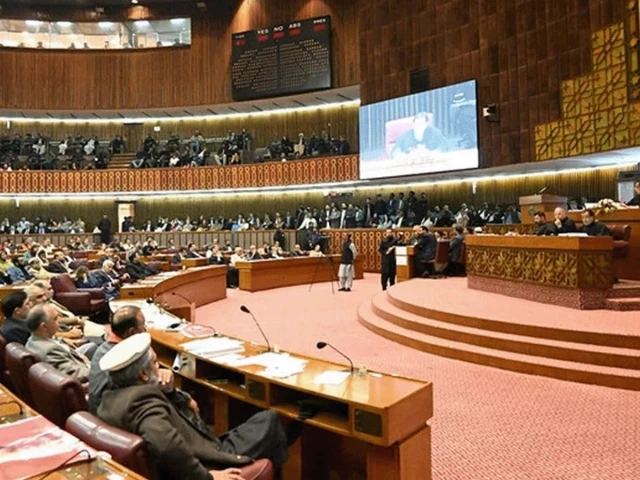
ISLAMABAD: Two resolutions seeking to ratify presidential proclamations imposing a state of emergency and governor’s rule in Khyber-Pakhtunkhwa (K-P) were tabled at a joint sitting of parliament on Thursday amid opposition protests.
The federal government imposed the measures on October 11, suspending the Pakistan Tehreek-e-Insaf (PTI)-led provincial administration. It cited worsening security conditions and an alleged failure by the provincial government to coordinate counter-terrorism efforts with federal authorities.
National Assembly Speaker Ayaz Sadiq chaired Thursday’s joint session. Federal Minister for Parliamentary Affairs Dr Tariq Fazal Chaudhry presented the presidential proclamations concerning the emergency and governor’s rule.
The government presented the emergency proclamation under Article 232(7) of the Constitution. It also placed the proclamation concerning governor’s rule before lawmakers under Article 234(3).
Opposition lawmakers protested during the proceedings. Several members wore black armbands to register their opposition to the measures.
Parliament Approves Procedural Motion
Chaudhry later moved a motion under Rule 232 of the Parliament (Joint Sitting) Rules, 1973, seeking to suspend certain sub-rules and allow the session to proceed.
Opposition members opposed the motion. However, Speaker Ayaz Sadiq put it to a vote by asking lawmakers to stand.
The motion passed with 214 votes in favour and 56 against.
Following the vote, Chaudhry moved two separate resolutions. One sought ratification of the emergency proclamation under Article 232, while the other sought approval of the proclamation imposing governor’s rule under Article 234.
Law Minister Azam Nazeer Tarar then opened the debate and defended the government’s decision.
Tarar Calls Emergency a ‘Last Resort’
Tarar described the emergency as a “last resort”, citing the worsening security situation and deliberations by the federal cabinet.
He urged lawmakers to approve the proclamations under Articles 232 and 234. He also said the government was ready to answer questions about the decision and rejected comparisons with martial law.
“This option was exercised as a last resort,” he said.
According to Tarar, the K-P governor had sent a detailed letter to the president and prime minister outlining the province’s conditions. The letter warned that the conflict involving terrorism was intensifying, he added.
The minister said the prime minister reviewed the material before placing the matter before the federal cabinet. He said the cabinet discussed the issue for two and a half hours before recommending that the prime minister advise the president to invoke the relevant constitutional powers.
Tarar also criticised the provincial leadership’s priorities, referring to deaths in incidents in Tank and Bajaur.
He said families were receiving condolences while injured people remained under treatment in hospitals. Doctors were also assessing some patients to determine whether they needed limb amputations, he added.
“In my view, the chief minister and provincial ministers should be there, rather than at rallies where music is being played and there is an atmosphere of celebration,” he said.
Government Cites Counter-Terrorism Concerns
Tarar said discussions at the apex committee had raised concerns about the Counter Terrorism Department’s institutional structure and resources. He said the department lacked a fully developed structure and adequate resources.
The minister added that the federal government considered the broader security situation, the provincial administration’s conduct and the material presented during cabinet deliberations.
Responding to lawmakers who compared the emergency with martial law or the events of October 12, Tarar said the government had acted under constitutional provisions.
“The affairs of the state must be governed by the Constitution of Pakistan,” he said. “Whatever is provided for in the Constitution must be carried out in the manner it mandates.”
Tarar said he, the interior minister and the information minister had explained the government’s position to the media on October 11, after the proclamation was issued.
The government later presented its explanation in both houses of parliament, he added.
Tarar Explains Constitutional Process
Tarar said the Senate and National Assembly had separately debated and approved the emergency proclamation issued by President Asif Ali Zardari on October 11 under Article 232.
He referred to the 18th Amendment, saying it introduced safeguards requiring both chambers to consider the proclamation within 10 days and decide on its approval through resolutions.
He said the joint sitting also had a constitutional role in the process. According to Tarar, the proclamation would cease to remain in force if the joint sitting passed a resolution rejecting it by a majority of its total membership.
Turning to Article 234, the minister said it provided a mechanism for the exercise of a province’s administrative and legislative powers when the constitutional conditions for its invocation were met.
He added that a proclamation under Article 234 must also be placed before a joint sitting of parliament.
Tarar said the president had summoned Thursday’s session to fulfil these constitutional requirements after detailed discussions in the National Assembly and Senate. He also said the two proclamations before lawmakers formed part of the same document.
The minister described the 1973 Constitution as a consensus document shaped by extensive debate and consideration of Pakistan’s political circumstances. He said the Constitution remained important to the country’s people and democratic forces.
He welcomed questions from lawmakers on both sides of the aisle about the grounds and evidence behind the emergency.
Tarar also said the government had made a final effort to pursue negotiations. However, he declined to discuss competing political accounts, saying he wanted to focus on the legal aspects of the decision.
“I am speaking only from a legal point of view,” he said.
Peshawar School Roof Collapse Kills 30, Including 28 Children and Two Teachers
Thanking the National Assembly speaker and Senate chairman for allowing a detailed debate, Tarar urged lawmakers to examine the proclamations before deciding on the resolutions.
“The Constitution of Pakistan gives you the authority to decide on this,” he said.
Both Houses Previously Approved Emergency Proclamation
A day earlier, the National Assembly and Senate had approved President Zardari’s emergency proclamation for K-P by majority votes under Article 232(1), despite opposition objections.
In the National Assembly, Chaudhry presented the resolution before lawmakers. He also moved a separate motion to suspend Question Hour so the House could take up other parliamentary business.
Opposition lawmakers opposed the procedural motion, but the House adopted it by a majority vote.
Lawmakers then debated the emergency measures. Opposition members strongly criticised the federal government’s decision and protested during the proceedings.
Despite their objections, the National Assembly passed the resolution by a majority vote.