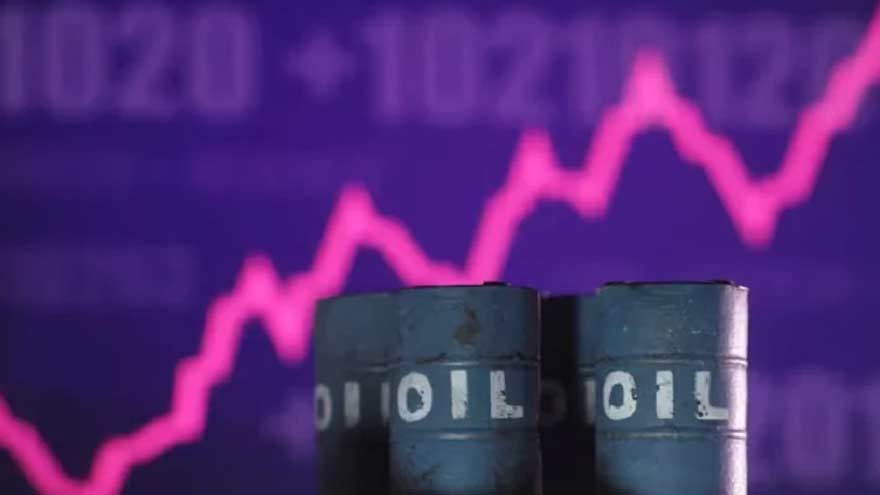
Oil prices climbed more than 3% on Friday, with Brent crude settling at its highest level in nearly six months. Houthi attacks in Saudi Arabia and an oil spill reported by the United Arab Emirates heightened concerns about potential disruptions to Middle East energy supplies.
Brent crude futures rose $3.55, or 3.14%, to settle at $116.72 per barrel. This marked their highest closing price since April 29.
US West Texas Intermediate (WTI) crude gained $3.80, or 3.8%, to settle at $103.27 per barrel.
For the week, Brent advanced 6%, while WTI gained 2.3%.
The latest rally reflected growing concerns about regional energy infrastructure and the security of oil supply routes. The reported UAE oil spill added to market uncertainty in a region critical to global energy markets.
Energy Stocks Reach Record High
Rising crude prices lifted Wall Street’s energy sector by 2.5% on Friday, pushing it to a record high.
Urfi Javed Praises Sheheryar Munawar, Recalls Memorable Dubai Meeting
However, the broader US stock market ended lower as investors weighed technology valuations, artificial intelligence spending and the outlook for inflation.
The Dow Jones Industrial Average fell 652.82 points, or 1.23%, to 52,215.16. The S&P 500 declined 39.75 points, or 0.52%, to 7,623.68, while the Nasdaq Composite slipped 53.52 points, or 0.21%, to 25,955.34.
For the week, the S&P 500 lost 0.5% and the Nasdaq fell 0.7%. The Dow bucked the trend, rising 0.4% and extending its weekly winning streak to three weeks.
AI Spending Keeps Technology Investors Cautious
Investors continued to question whether major technology companies will generate sufficient returns from their substantial artificial intelligence investments.
Semiconductor stocks recovered modestly on Friday. The Philadelphia Semiconductor Index rose 0.4% after recording its largest daily percentage decline since June on Thursday.
The S&P 500 technology index also gained 0.4%, although performance varied among major companies.
Meta Platforms shares fell 1%, while Microsoft rose 0.7%. Alphabet and Amazon shares edged lower.
A report involving Meta renewed concerns about the returns on heavy AI investment. Investors are now turning their attention to earnings reports from major technology companies scheduled for the coming week.
Alphabet, Microsoft and Amazon are among the companies expected to draw close scrutiny. Their spending plans and financial returns from AI remain central issues for investors.
“There’s still anxiety over the AI trade to a certain extent,” said Art Hogan, chief market strategist at B. Riley Wealth in Boston.
Other corporate results also weighed on sentiment. American Express shares dropped 3.7% after the company released quarterly results. Its chief executive said the business had good momentum but needed to become a more “agile and efficient” organisation.
Telecommunications stocks also came under pressure following a report that SpaceX was discussing a potential US wireless carrier programme with cellular infrastructure companies. The prospect raised concerns about increased competition in the sector.
US Treasury Yields Rise
US Treasury yields climbed on Friday after the benchmark 10-year yield recorded its sharpest one-day decline in nearly four years on Thursday.
The 10-year Treasury yield rose 3.7 basis points to 4.99%, remaining just below the 5% mark.
Persistent inflation concerns continued to influence bond market sentiment.
“There are still all these headwinds in terms of sticky inflation,” said JoAnne Bianco, partner and senior investment strategist at BondBloxx Investment Management in Chicago.
Higher borrowing costs can affect corporate financing, consumer spending and valuations across financial markets.
European Shares Extend Weekly Losses
European stocks fell for a second consecutive session. The pan-European STOXX 600 declined 0.31% to 635.77 points.
The index lost approximately 1.4% over the week, recording its steepest weekly decline since early September.
The euro weakened 0.21% to $1.1191 amid concerns about political unrest and budget difficulties in France.
French government bond yields declined on Friday but remained sharply higher for the week. The premium investors demand to hold French government debt over safer benchmark bonds also rose to its highest level since the eurozone sovereign debt crisis in 2011.
Markets Watch Oil Supply and Earnings
Investors are expected to monitor developments in the Middle East for signs of further disruption to oil production, energy infrastructure and export routes.
Meanwhile, corporate earnings and inflation data will help shape market sentiment in the coming week.
Continued supply concerns could keep oil prices elevated, while uncertainty over AI spending and borrowing costs may influence the performance of global equities.











[…] Oil Prices Surge as Middle East Tensions Push Brent to Six-Month High […]