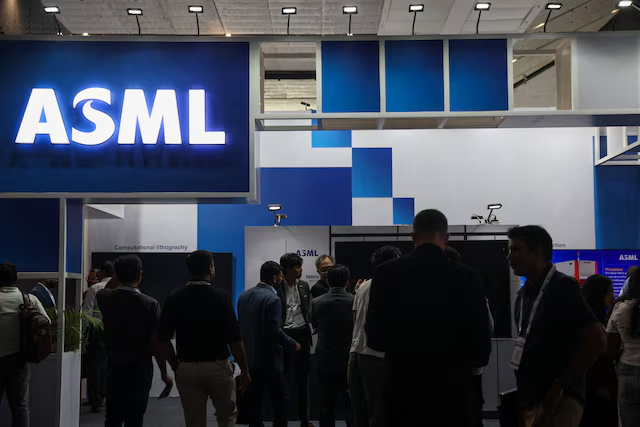
Dutch chipmaking equipment manufacturer ASML expects strong demand for its machines through 2030 as the artificial intelligence boom fuels investment in semiconductor production.
The company said on Wednesday that customers wanted more production capacity than ASML could supply next year and through 2028. Some customers have also started discussing orders beyond 2027, including potential bookings for 2029 and 2030.
The surge in demand reflects the rapid expansion of AI infrastructure and data centres. Major chipmakers, including Taiwan Semiconductor Manufacturing Company (TSMC), Samsung and Intel, are investing heavily to expand production capacity.
TSMC manufactures chips for Nvidia and other technology companies. Meanwhile, ASML supplies equipment used to produce some of the world’s most advanced semiconductors.
ASML shares have gained nearly 70% this year, reflecting investor optimism about the industry’s growth prospects.
ASML Plans Further Capacity Expansion
ASML is exploring additional ways to increase production capacity as demand continues to outpace supply.
In July, the company announced plans to raise capacity by 30% in 2027 and another 30% in 2028. However, Chief Executive Officer Christophe Fouquet said those increases would not be enough to meet customer demand.
Champions League Brugge Stun Inter 4-3 as Bayern Drop Points Against Viking
“We are seeing a lot of order intake for 2028. But also some strong interest to already place orders for 2029 and sometimes even 2030,” Fouquet said.
ASML broke ground last month on a major expansion in Eindhoven, the Netherlands. The first phase is expected to finish in 2029. Until then, the company plans to use other measures to increase output.
Chief Financial Officer Roger Dassen said ASML would upgrade existing equipment and introduce newer machines capable of processing more wafers. These measures should significantly increase customers’ production capacity.
Dassen also said ASML would raise prices from 2027, with the full impact becoming visible in 2028.
Strong Results Improve Sales Forecast
ASML’s latest results and improved outlook prompted the company to raise the lower end of its full-year sales forecast.
The company now expects fourth-quarter sales of €14.2 billion to €15.2 billion, equivalent to approximately $15.9 billion to $17 billion. It also forecasts a gross margin of around 57%.
ASML consequently raised its full-year sales forecast to €44 billion to €45 billion.
For the third quarter, the company reported net profit of €4.96 billion on net sales of €11.7 billion. Analysts polled by LSEG had expected net profit of €4.05 billion, while sales broadly matched expectations.
ASML’s market value stood at approximately €586 billion, or $657 billion. Its shares rose nearly 3% in early Amsterdam trading following the announcement.
ING analyst Marc Hesselink said the results exceeded expectations. He also anticipated upward revisions to analysts’ earnings forecasts through 2028.
“Management’s commentary on demand visibility and capacity … was again very constructive,” Hesselink said.
Chipmakers Race to Secure Equipment
ASML’s customers include SK Hynix and Micron, both of which have expansion plans. The company is also assessing the potential opportunity from Elon Musk’s proposed Terafab semiconductor project.
Dassen said ASML was still evaluating the project’s potential scale.
Nick Rossolillo of Chip Stock Investor, which owns ASML shares, welcomed the company’s measured approach to expanding capacity.
He said gradual expansion could help ASML meet customer demand while protecting the business from future downturns.
Rossolillo also warned that customer orders could weaken in 2028 and 2029 after several new semiconductor plants become operational.
ASML’s outlook highlights the growing pressure on semiconductor equipment suppliers as chipmakers race to support AI development. However, the company must balance additional investment against the risk of excess capacity if customer spending eventually slows.









[…] ASML Sees AI Chip Demand Driving Orders Through 2030 […]