Pakistan’s favourable tax and duty treatment for New Energy Vehicles (NEVs) could result in an estimated annual revenue concession of around Rs150 billion, according to former Pakistan Association of Automotive Parts and Accessories Manufacturers (PAPAAM) chairman Abdul Rehman.
Rehman said annual NEV sales could reach about 50,000 units under the current policy framework.
He estimated that the average reduction in duties and taxes could amount to around Rs3 million per vehicle.
Based on these estimates, the government could forgo approximately Rs150 billion in potential annual revenue.
Rehman described the concession as a major fiscal policy decision. He argued that the government must consider the opportunity cost of revenue it chooses not to collect.
NEV Transition Has Wider Economic Benefits
Rehman acknowledged the need for Pakistan to transition towards electric mobility.
He said electric vehicles could help reduce fuel imports and emissions. The sector could also support the development of a domestic electric-vehicle industry.
However, he questioned whether subsidising expensive private vehicles was the most effective way to achieve those goals.
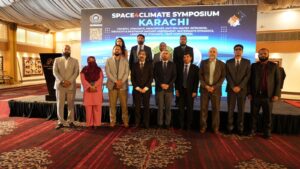
SUPARCO Hosts Fourth Space4Climate Regional Symposium in Karachi
“If the government has fiscal space equivalent to Rs150 billion to accelerate electric mobility, there are alternative uses that could benefit a far larger section of society,” he said.
He pointed to electric buses, charging infrastructure, electric motorcycles and rickshaws as possible alternatives.
He also highlighted public transport systems and local battery and component manufacturing.
Industry Expert Questions Subsidy Priorities
Rehman said the key issue was not whether NEVs should receive government support.
Instead, he argued that policymakers should assess whether the current incentives provide the greatest economic and social return.
He said public subsidies should generate benefits proportionate to their fiscal cost.
Rehman also compared the estimated NEV revenue concession with Pakistan’s higher education spending.
According to his statement, the Higher Education Commission (HEC) received approximately Rs35 billion for FY2025-26.
The estimated annual NEV concession of Rs150 billion would therefore be more than four times that allocation.
He said the comparison should encourage policymakers to reconsider national spending priorities.
Focus on Public Transport and Mass Mobility
Rehman argued that Pakistan’s young population needs greater investment in universities, skills, research and technology.
He also highlighted the need for employment opportunities and reliable public transport in major cities.
According to him, incentives should be designed according to the government’s primary objective.
If industrial development is the goal, he said policies should include clear requirements for localisation, investment and job creation.
If mass adoption of electric mobility is the objective, incentives should reach people who depend on motorcycles, rickshaws and public transport.
He argued that support should not primarily benefit consumers who can already afford high-value vehicles.
Calls for More Targeted NEV Policy
Rehman concluded that effective policy should focus on where public resources can generate the greatest economic and social benefits.
He said choosing the right technology alone does not guarantee good policy.
The broader question, he argued, is how Pakistan can use limited fiscal resources to support cleaner transport while also promoting industrial development, public mobility and wider economic opportunity.







[…] NEV Tax Incentives Could Cost Pakistan Rs150bn in Annual Revenue […]