WASHINGTON: A discarded SpaceX Rocket stage is believed to have crashed into the Moon at high speed on Wednesday after drifting through space for more than a year. Scientists said the impact posed no danger to Earth but was expected to create a fresh lunar crater and provide researchers with a rare opportunity to study an artificial collision on the Moon’s surface.
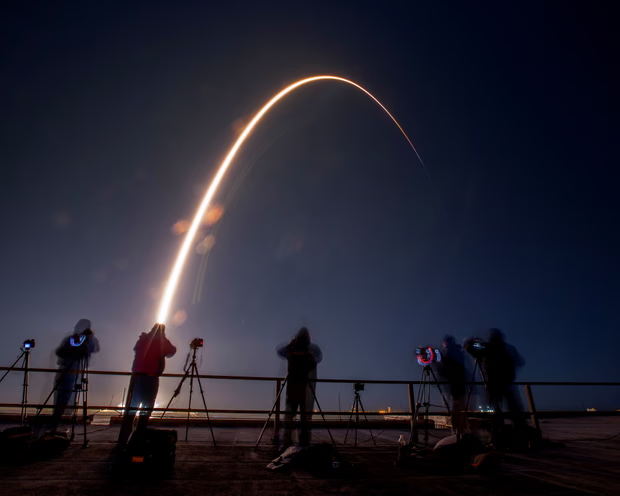
The approximately four-tonne rocket stage was part of a Falcon 9 mission that launched a Firefly Aerospace lunar lander in January 2025. After completing its mission, the second stage remained in space because the lunar journey required more energy than missions in Earth orbit.
High-Speed Impact Expected
More than 100 words into the event, the SpaceX Rocket stage was expected to strike the Moon at around 5,400 miles per hour (8,690 km/h).
NASA estimated the collision would create a crater roughly 60 feet (18 metres) wide and 12 feet (4 metres) deep. The impact was also expected to send dust and rocks high above the lunar surface.
Astronomers were unable to immediately confirm the collision because the predicted impact site was located near the visible edge of the Moon, making direct observation difficult even with powerful telescopes.
PSX Rally Lifts KSE-100 Index by Over 2,500 Points on Global, China Funding Optimism
NASA to Study the Collision
NASA said it plans to capture images of the impact site before and after the collision whenever possible.
The agency believes the data could improve scientists’ understanding of artificial impacts and help refine methods for tracking objects in deep space.
NASA spokesperson Jimi Russell said the event posed no threat to Earth and would provide an opportunity to collect valuable lunar data.
Space Junk Remains a Growing Challenge
Rocket stages usually burn up in Earth’s atmosphere or fall into the ocean after completing their missions. However, spacecraft travelling beyond Earth often leave upper stages in space because they lack enough fuel to return safely.
Astronomers only confirmed earlier this year that the uncontrolled Falcon 9 rocket stage had entered an orbit that would eventually intersect with the Moon.
Julianna Scheiman, SpaceX’s Director of NASA Science and Dragon Programmes, said a combination of solar activity and gravitational forces gradually pushed the rocket stage onto its lunar trajectory.
Astronomer Bill Gray, who first reported the expected impact, said the collision posed no danger but highlighted the need for better management of discarded space hardware.
Rare Lunar Collisions
Artificial impacts on the Moon remain uncommon. A Chinese rocket stage struck the lunar surface in 2022 after completing a test mission, while NASA intentionally crashed a rocket stage into the Moon in 2009 to study the debris plume.
Several lunar landers have also crashed during landing attempts in recent years, including Russia’s Luna-25, India’s Chandrayaan-2, and Israel’s Beresheet mission.
NASA and SpaceX said they are discussing ways to reduce the likelihood of similar unintended impacts during future lunar missions.











[…] SpaceX Rocket Stage Believed to Crash Into Moon, Creating New Lunar Crater […]