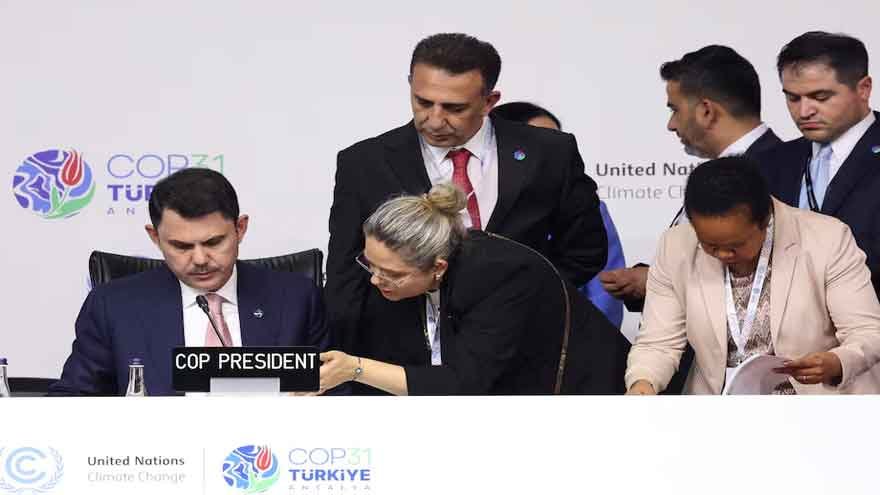
Climate negotiations at COP31 in Antalya, Turkey, moved closer to a final agreement on Sunday. Australia and Turkey presented a revised package aimed at securing consensus on efforts to tackle global warming.
COP31 President Murat Kurum told a late-night plenary session that the proposed text could win support from all participating countries.
“We believe that we have put forward a text which all the parties can agree upon,” Kurum said.
He added that delegates would reconvene later on Sunday morning to consider and approve the agreement.
Negotiators continued discussions beyond the original Friday deadline. Talks stretched through Saturday and into the early hours of Sunday as countries worked to resolve major differences.
The revised draft followed criticism of an earlier version. Some delegations had argued that the previous text lacked ambition because it did not mention ending the use of fossil fuels.
Kurum said the latest package addressed concerns over fossil fuels. He also said it considered the need to help developing countries finance climate adaptation measures.
Karachi Education Board Honours Students’ Week Position Holders at Prize Distribution Ceremony
The agreement followed intensive consultations involving Australia, Turkey and nearly 200 national delegations. The negotiations brought together countries with widely different economic interests and levels of vulnerability to climate change.
Australia led the negotiations, while Turkey hosted the conference. Their challenge was to balance the demands of countries most exposed to climate impacts with the interests of economies that rely on producing or consuming fossil fuels.
Under the proposed schedule, delegations had until 0300 GMT to raise objections. A session was scheduled for 0600 GMT to begin the approval process.
The negotiations took place amid growing concern over the global temperature rise. This year’s COP is the first since the UN’s environmental body confirmed that global warming is on course to exceed the 1.5-degree Celsius threshold.
Countries agreed more than a decade ago to pursue efforts to limit warming to 1.5°C above pre-industrial levels. Scientists warn that exceeding this threshold would intensify the impacts of extreme weather and other climate-related risks.