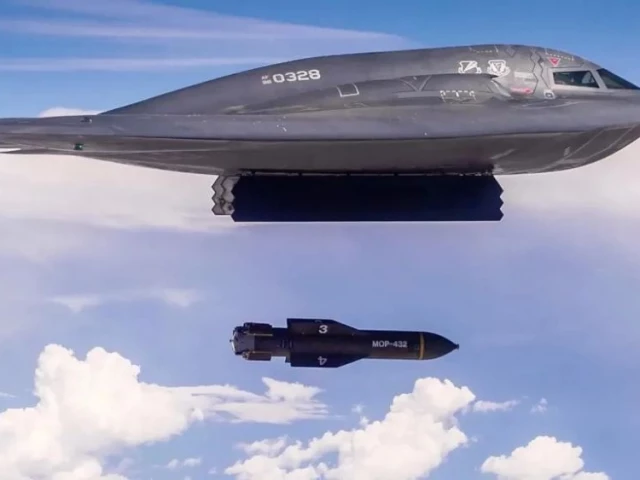
WASHINGTON: The US military has developed strike plans that could include using its largest non-nuclear bomb against Iranian energy infrastructure and nuclear sites if President Donald Trump orders renewed combat operations, CNN reported on Thursday, citing US officials familiar with the discussions.
The weapon, known as the GBU-43/B Massive Ordnance Air Blast (MOAB) bomb, is commonly called the “mother of all bombs”.
Its potential use would mark a major escalation in the conflict. However, officials familiar with the planning discussions questioned whether the weapon would achieve Washington’s strategic objectives, CNN reported.
Reuters said it could not immediately verify the report.
Trump Predicts War Will End ‘Very Soon’
Trump said late Wednesday that the war with Iran would end “very soon”. He also predicted a sharp decline in oil prices once the conflict ended.
“The Iran war will end very soon … Soon, as they want it to end,” Trump told reporters in Montana.
“They’ll never have a nuclear weapon, and oil prices will drop like a rock,” he added.
Earlier, Trump addressed a rally in Montana, where he expressed uncertainty about which Iranian officials were involved in negotiations with Washington.
“They don’t have a navy. They don’t have an air force. Their army is decimated. Their leaders are gone,” he said.
“I should have probably left their leaders because I don’t know who the hell we’re negotiating with,” Trump added.
The president also described Iran as a former dominant military power in the Middle East. He argued that US military operations had significantly weakened its capabilities.
“Iran was the bully of the Middle East,” Trump said, adding that the country was no longer as powerful as before.
He claimed that US strikes had destroyed Iran’s naval fleet and left its military aircraft unusable.
Trump said Iran had 159 ships and asserted that none remained operational. He also claimed that US strikes had destroyed the country’s fighter jets on their runways.
However, the claims about Iran’s military losses were statements by Trump and were not independently verified in the supplied report.
Two Ships Sink Near Strait of Hormuz
Meanwhile, a container ship and a dry bulk carrier sank near the Strait of Hormuz within 24 hours after separate projectile attacks, maritime officials said on Wednesday.
Attacks around the strategic waterway have intensified over the preceding 10 days. Iran has said it is increasing strikes in response to the US blockade of its ports and tighter sanctions introduced last month.
The Singapore-flagged container ship GFS Pride sank while transiting the strait, according to maritime security sources.
The Maritime and Port Authority of Singapore said the vessel suffered damage and caught fire before sinking. All 21 crew members were evacuated safely, and no injuries were reported.
The ship, which could carry 2,824 twenty-foot equivalent units (TEUs), had been sailing through the strait on Tuesday, the authority said.
In a separate incident, the Antigua and Barbuda-flagged Cape Dao sank near the strait. The vessel had been struck by a projectile on September 23, according to data from the International Maritime Organization (IMO).
Maritime sources said one crew member died in that incident, while the remaining crew members evacuated after the strike.
The vessel’s UAE-based manager, Peonies Shipmanagement FZE, could not immediately be reached for comment.
The GFS Pride and Cape Dao were the second and third vessels to sink since the US-Iran war began on February 28, according to an analysis of IMO casualty data cited in the report.
Singapore’s maritime authority expressed concern over the continued attacks on commercial shipping.
“Such attacks are unprovoked, unjustifiable, and a breach of international law,” it said.
The GFS Pride’s UAE-based manager, GFS Ship Management FZE, could not immediately be reached for comment.
Maritime risk management company MARISKS warned that the incidents highlighted the growing threat to commercial vessels passing through the waterway.
“The threat is not confined to tankers, with container vessels and bulk carriers also sustaining serious damage,” the company said.
Iran Tightens Grip on Strategic Waterway
The escalation has heightened concerns about maritime security in the Strait of Hormuz, a critical route through which about one-fifth of global oil and liquefied natural gas trade passed before the war.
Tehran has sought greater control over the waterway since US and Israeli strikes against Iran began on February 28. Restrictions on shipping have also given Iran a potential source of leverage over Washington.
Two senior Iranian officials told Reuters that Iran was increasingly using new tactics against vessels transiting the strait. They said Tehran sought to keep oil prices elevated and influence US midterm elections.
Although the US and Iran have focused attacks on tankers, other commercial vessels have also come under fire, suffered damage or sunk.
In March, a projectile struck the Maltese-flagged container ship Safeen Prestige, which later sank north of the Strait of Hormuz.
In April, Iran’s Islamic Revolutionary Guard Corps attacked and seized the container ship MSC Francesca.
The incidents have broadened concerns beyond energy shipments, with container ships and bulk carriers also facing serious risks as the conflict continues.