/ Oct 22, 2026
Trending
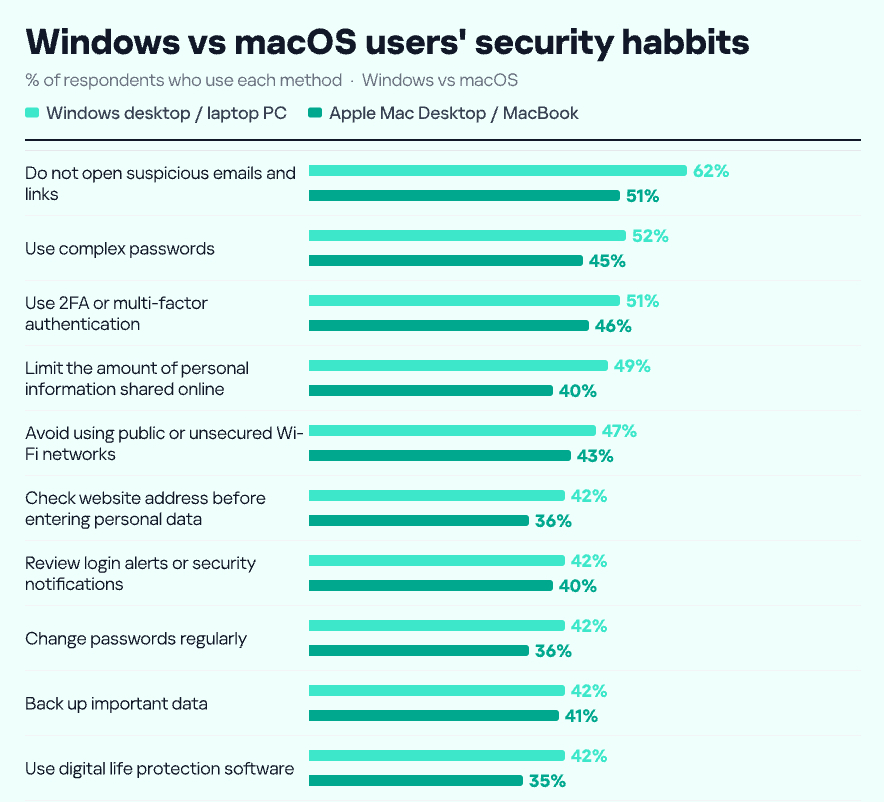
Mac users appear to be less consistent than Windows users when it comes to basic cybersecurity practices, according to a latest Kaspersky survey.
Over the past year, 12% of macOS users surveyed reported experiencing malware infections. By comparison, 9% of Windows users reported the same issue.
The survey also found a significant gap in the use of dedicated security software. Only 35% of macOS users said they use security software, compared with 42% of Windows users.
According to Kaspersky security experts, the adoption rate among Mac users remains worryingly low despite the changing cyber threat landscape.
The biggest difference appeared in how users handle suspicious emails and links.
Around 62% of Windows users said they avoid opening suspicious emails or links. Meanwhile, only 51% of macOS users reported following the same practice.
This difference highlights the importance of basic cybersecurity awareness. Phishing messages and malicious links remain common methods used by cybercriminals to target internet users.
Furthermore, macOS users reported higher exposure to several forms of online fraud.
KATI, Shahid Afridi Foundation Sign MoU to Expand Social Welfare Projects
The survey found that 16% of Mac users experienced online scams or investment fraud, compared with 13% of Windows users. Privacy violations affected 11% of macOS users and 8% of Windows users.
Personal data theft also showed a notable gap. About 12% of Mac users reported experiencing it, compared with 7% of Windows users.
Windows users also reported stronger password security habits.
For example, 38% of Windows users said they use a unique password for every account. The figure was 35% among macOS users.
Similarly, 52% of Windows users reported using complex passwords, compared with 45% of Mac users.
Two-factor or multi-factor authentication showed another difference. Around 51% of Windows users said they use these security measures, while 46% of macOS users reported doing so.
As a result, Kaspersky recommends stronger password practices and additional security measures across all operating systems.
A dedicated password manager can provide another layer of protection, particularly for users managing multiple online accounts.
Such tools store credentials in a secure vault protected by a master password. Therefore, users do not need to remember numerous passwords individually.
Modern password managers can also support passkeys and other authentication methods. These features can simplify secure sign-ins across multiple devices through encrypted synchronization.
Kaspersky highlighted its own Password Manager as an example of such a solution.
The company also cited independent testing of its security products. According to Kaspersky, AV-TEST recognised Kaspersky Premium for macOS as a top-performing macOS security solution in 2025 based on its evaluation results.
Sergey Puzan, a cybersecurity expert at Kaspersky, said the belief that Macs are automatically safer can create a false sense of security.
He noted that some users assume cybercriminals target macOS less because of its smaller user base. Others rely heavily on the platform’s built-in security features.
However, the threat landscape has changed significantly.
“Attackers actively employ phishing and commit supply chain attacks, which often allow them to affect users of any operating system in a single malware campaign,” Puzan said.
He added that malware targeting Macs is not uncommon and that some malware families are designed specifically for macOS.
Consequently, Puzan stressed that every internet-connected device needs appropriate cybersecurity protection, regardless of its operating system.
The survey ultimately highlights a broader cybersecurity lesson: strong digital protection depends not only on built-in technology but also on user behaviour, secure passwords, authentication and awareness of online threats.













[…] Mac Users Lag Behind Windows Users in Cybersecurity Practices, Kaspersky Survey Finds […]